People from Kempten Who Shape Cultural Life
People from Kempten Who Shape Cultural Life: Preview of an Upcoming Portrait Series (2026–2027)
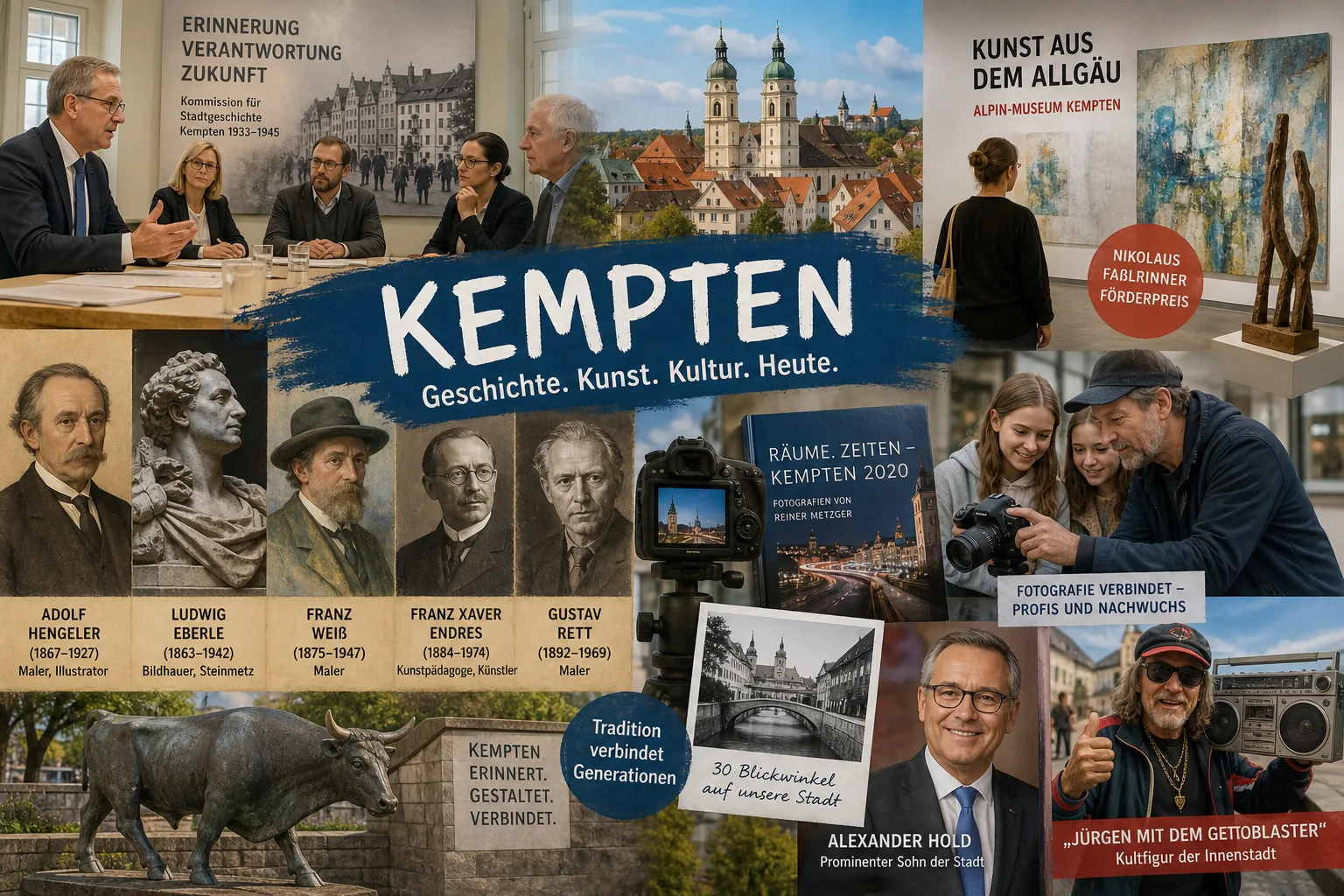
In the coming months, we will focus in an ongoing portrait and thematic series on people and roles that make Kempten's culture visible: from remembrance culture and art mediation to photography and everyday culture. This page is the preview of all planned contributions and dates – looking exclusively ahead.
Who is this for? For locals who want to read Kempten in a new way, and for visitors who want to classify future cultural impulses (formats, topics, perspectives) at an early stage.
What the Series is About
Starting in autumn 2026, we will introduce in several articles people and functions that can shape Kempten's cultural life in the future: curators and mediators, actors of remembrance culture, art educators, photography initiatives, media personalities, and figures of everyday culture. The focus is not on “big names at any cost,” but on concrete cultural impact:
- What does this make possible for the city? (e.g., new formats, perspectives, spaces for discussion)
- How is publicity created? (e.g., urban space, school, museum, media)
- How is responsibility assumed? (e.g., with historical topics, remembrance, contextualization)
Each article is planned so that it remains understandable without prior knowledge and at the same time offers enough depth for readers who want to systematically explore Kempten's cultural landscape in the future.
Planned Program: Dates & Topics (from October 2026)
The following publications are planned as editorial dates. All content is formulated as a preview and will be updated and reviewed on each date.
1) October 20, 2026: Kick-off – Remembrance Culture as Work for the Future
The kick-off article is expected to explain how remembrance culture in Kempten can become visible in urban space and educational contexts in the future: What questions arise with plaques, contextual formats, naming, and educational offerings – and what roles do administration, committees, historians, schools, initiatives, and the public play?
2) November 17, 2026: Art in Urban Space – Why Sculptures Will Be More Than “Decoration” in the Future
This article is expected to show how art in public space can stimulate orientation, culture of debate, and city identity in the coming years – and how to recognize whether a work really functions as a “public anchor” (accessibility, context, maintenance, mediation).
3) December 15, 2026: Art Mediation & School – Who Will Inspire Future Generations for Design
Planned is a look at art education, workshops, and low-threshold formats: What is needed so that young people in Kempten not only consume but also create themselves in the future – with real exhibition opportunities, cooperations, and fair framework conditions?
4) January 19, 2027: Photography as a City Conversation – New Perspectives on Familiar Places
Planned is an article about how long-term and community photography projects can sharpen perception in the future: What makes a series “readable”? How do dialogues between generations arise? And how can participation be organized without losing quality?
5) February 16, 2027: Everyday Culture & Local Icons – How City Feeling Will Be Formed in the Future
This part is expected to address the question of how everyday culture arises: through recurring figures, sounds, rituals, media images, and places. The focus is on how to talk about it respectfully without appropriating people or reinforcing clichés.
6) March 16, 2027: “Seeing Kempten Anew” – Practical Route for the Coming Months
In conclusion, a compact, future-oriented exploration route is planned: a sequence of perspectives (urban space → museum → school → photography → media/everyday life), which can be revisited in the following weeks – depending on which exhibitions, tours, or discussions arise.
How We Work: Transparency, Selection Criteria, Handling Sensitive Topics
Selection Criteria (for Upcoming Portraits)
- Comprehensible contribution to cultural life (e.g., mediation, curating, designing, moderating, documenting).
- Public relevance: Impact beyond private circles (e.g., city conversation, educational reference, urban space reference).
- Respect & context: no denigration, no sensationalism, clear classification.
- Verifiability: When concrete statements are made, they are supported in the respective articles with reliable evidence or primary sources.
Handling Remembrance Culture and Potentially Sensitive Topics
If the series touches on historical, political, or biographically sensitive aspects in the future, the following applies: We prioritize context, clarity of sources, and the perspective of how societies remember responsibly. We avoid speculation about the motives of individuals and clearly separate proven facts, interpretation, and commentary.
Why This Series Consciously Focuses on the “Future”
This preview and the planned articles are designed to empower readers: What questions should be asked in the future? Which formats have proven to work? How can you recognize fair, inclusive cultural work? The benefit lies in the forward-looking overview, not in a retrospective.
Get Involved: Suggestions, Perspectives, Materials
If you would like us to consider a person, a format, or a role in one of the upcoming articles, you can send us suggestions (before the respective dates) that can be verified without speculation. Particularly helpful for editorial work are:
- Links to official announcements (institutions, programs, press information)
- References to public events that are still upcoming (with date, location, and organizer)
- Materials for mediation (e.g., catalogs, program booklets, public lectures)
- Contact options for interviews (with the consent of the person concerned)
This way, the series can become more concrete in the future without relying on hearsay or unclear attributions.
Sources & Standards
For the future classification of remembrance culture, public cultural heritage, and museum/mediation work, we orient ourselves to recognized foundations and institutions:
- UNESCO – World Heritage (Foundations & Terms) — Reference framework for cultural heritage and public responsibility (accessed 2026-10-07)
- German UNESCO Commission — Classification of culture, education, and participation in the public mandate (accessed 2026-10-07)
- Federal Agency for Civic Education (bpb) — Background on civic education, remembrance culture, and public debate (accessed 2026-10-07)
- ICOM – International Council of Museums — Standards and orientation for museum work and mediation (accessed 2026-10-07)