Civic Participation and Urban Development in Kempten
Civic Participation & Urban Development in Kempten: What’s Planned Next
What would Kempten look like if feedback on urban development were not only collected at the end of a process, but early on, transparently, and conveniently from home? In the upcoming planning and participation rounds, the city (like many municipalities in Germany) will likely rely more on digital formats, map-based participation, and vivid visualizations to make discussions more comprehensible and reach more people.
This article summarizes which participation formats could typically play a role in Kempten in the future, how a digital citizens’ forum and a 3D city model (“Digital Twin”) are intended to increase understanding, and which guardrails are important for fair, safe, and effective participation.
Why Participation Will Change
Urban development in the coming years will be increasingly shaped by conflicting goals: climate adaptation, land scarcity, mobility transition, affordable housing, repurposing in the city center, and the question of how public spaces should be used. For decisions to be accepted and improved, participation will need to meet three main requirements in the future:
- Timeliness: Feedback should not only be collected when plans are practically finished.
- Comprehensibility: It should be clear which options are being discussed, what trade-offs are being made, and how input is incorporated.
- Accessibility: Formats should work even if people have little time, are mobility-impaired, or prefer written discussions.
Digital tools will likely play a greater role because they can bundle information, structure contributions, and decouple participation from time constraints. At the same time, analog formats will still be needed so that people without digital experience can participate and sensitive topics can be clarified in direct conversation.
Digital Participation: Forum, Surveys, Debate Spaces
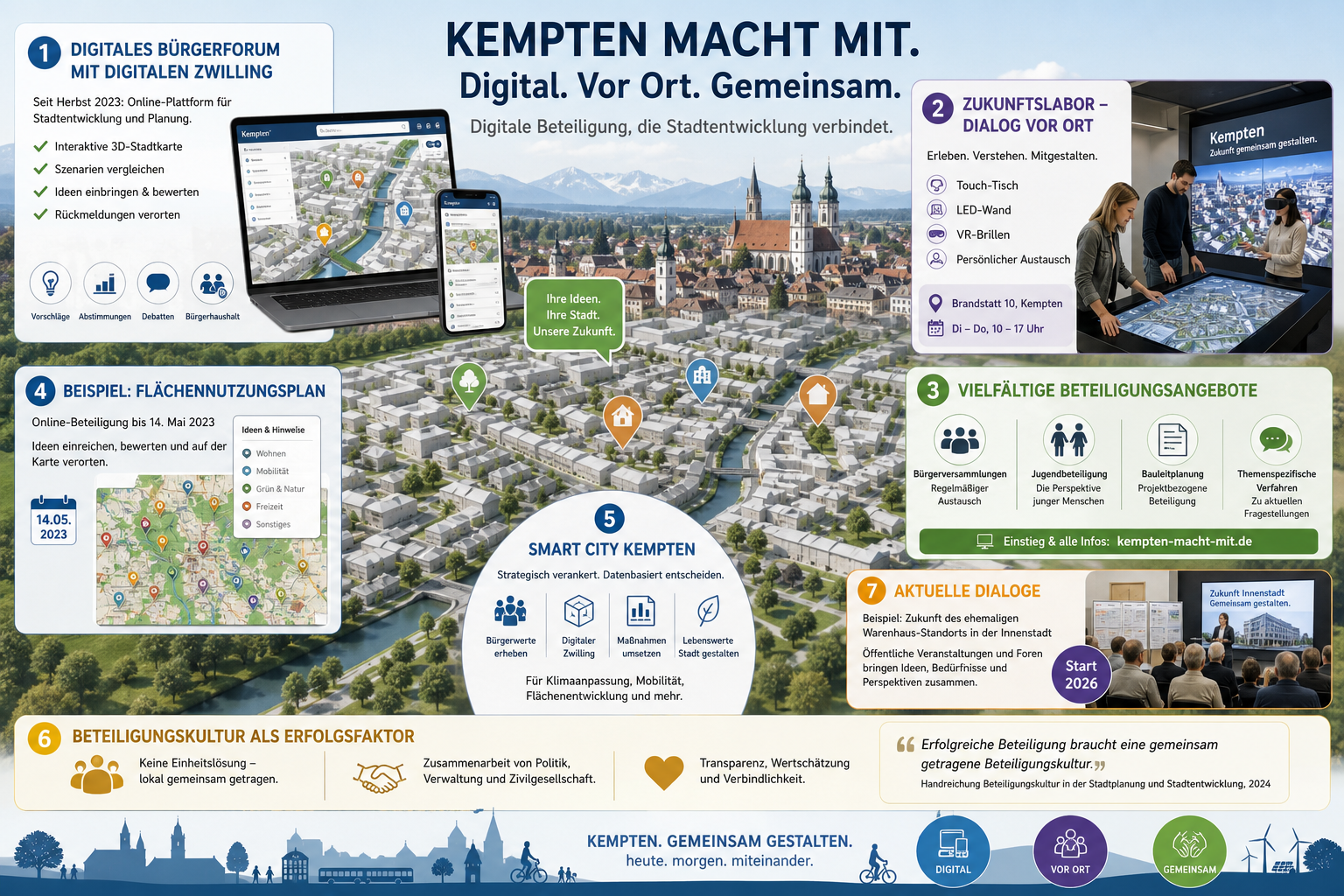
In future participation rounds, Kempten will likely work more often with a digital citizens’ forum or comparable online platforms. Such platforms are intended to present city projects in an understandable way, announce participation phases, and record contributions in a structured manner.
Which Functions Will Typically Be Offered in Upcoming Procedures
- Project pages with timeline: Goals, background, participation deadlines, and next decision steps are bundled in one place.
- Idea and suggestion modules: Contributions can be collected, thematically clustered, and exported for evaluation.
- Commented discussions: Pro and con arguments can be transparently documented.
- Surveys and polls: Sentiments can be gathered when it’s clear what they will be used for (e.g., prioritizing measures).
- Feedback reports: After a phase is completed, it can be published which suggestions were taken up and why others were not implemented.
For reliable participation, it will be crucial that digital contributions are not only collected but also evaluated and fed back: What was understood? What was adopted? What was not feasible – and for what reason?
3D City Model (“Digital Twin”): Making Plans Understandable in Advance
In upcoming projects, a 3D city model (“Digital Twin”) can help make plans understandable not only through texts and drawings, but spatially. This is particularly helpful when it comes to building heights, shading, traffic routing, quality of stay, or the effect of green spaces.
What a Digital Twin Can Achieve in the Future
- Orientation: Measures become visible on a map and in spatial context (Where exactly is what happening?).
- Scenarios: Variants can be compared (e.g., more greenery vs. more parking spaces, different route layouts).
- On-site participation: Suggestions can be located directly at a spot (pin/marker with justification).
- Explainability: Complex planning content becomes more vivid, even for people without technical knowledge.
It is important that visualizations in future procedures are marked as planning and communication aids: A 3D model makes options more visible but does not replace formal resolutions, environmental assessments, or legally required steps in land-use planning.
Hybrid Participation: Join Online and Deepen On Site
In the next participation formats, a hybrid approach will likely prevail: Online information and online feedback will be combined with on-site appointments. This can increase reach and at the same time create space for in-depth discussions.
This Is What a Hybrid Format Could Look Like in the Future
- Start phase (online): Project presentation, key questions, map display, and initial commenting phase.
- Dialogue phase (on site): Workshop/Open evening where conflicts, priorities, and alternatives are clarified together.
- Deepening (online): Summary, comparison of variants in the 3D model, second feedback round.
- Conclusion (transparent): Results report with justifications and outlook on the next formal steps.
To keep hybrid procedures fair, information from on-site appointments should also be documented online afterwards so that no one is disadvantaged who cannot attend.
How Future Planning Processes Will Typically Proceed
Many topics in urban development in Germany are governed by formal procedures (e.g., land-use planning). In the next Kempten procedures, it can therefore be expected that informal participation (dialogue, online feedback, workshops) will be combined with formal participation steps.
Typical Stages to Expect in Upcoming Procedures
- Clarification of problems and goals: What should be improved (e.g., safety, climate adaptation, diversity of use)?
- Development of variants: Several solutions are developed and presented in a comprehensible way.
- Early public participation: Suggestions are collected before details are finalized.
- Review and weighing: Feedback is evaluated (feasibility, cost framework, environment, law, social impact).
- Formal disclosure/objection phase: Statutory participation steps are carried out.
- Resolution and implementation: Decision, implementation planning, communication of the next milestones.
When digital participation is used, it should be designed in the next procedures so that contributions are not just “counted” but qualitatively evaluated: Which arguments are repeated? Where are there conflicting goals? Which suggestions provide local experiential knowledge (e.g., routes that are actually used)?
How You Can Get Involved in the Next Procedures
Anyone who wants to help shape Kempten in the future can typically participate in three ways: digitally, on site, and through well-founded contributions. What matters is not being “loud,” but arguing comprehensibly and—if possible—naming specific locations.
- Participate digitally: Watch for announced online participation (forum/platform, surveys, map feedback) and use deadlines to submit contributions.
- Attend on-site appointments: Use discussion evenings, workshops, or exhibitions to ask questions and compare variants.
- Make contributions concrete: Describe effects and everyday experience (e.g., “There’s a traffic jam here at school start,” “This path is unsafe for children,” “There’s no shade here in summer”).
- Consider other perspectives: Urban development affects many groups (children, elderly, cyclists, delivery traffic, people with disabilities, residents, businesses). Contributions are stronger when they take trade-offs into account.
Good participation in upcoming procedures will be recognizable by the fact that feedback does not disappear into the void, but reappears in understandable results reports—with clear justification.
Sources
- Building Code (BauGB) — Basics of land-use planning and public participation (retrieved on 2026-05-27)
- Federal Ministry of the Interior and Community (BMI): Smart Cities / Model Projects Smart Cities — Framework and background on municipal digitization (retrieved on 2026-05-27)
- OECD: Open Government — International guidelines on transparency, participation, and accountability (retrieved on 2026-05-27)
- European Commission: Joinup — Information on interoperable, open digital solutions in the public sector (retrieved on 2026-05-27)