
Kempten
Residenzpl. 4-6, 87435 Kempten (Allgäu), Deutschland
Residence Kempten | Tours & Opening Hours
The residence in Kempten (Allgäu) is considered one of the most significant baroque sites in southern Germany. Located directly at the Residence Square, the state rooms offer a vivid glimpse into the time of the prince abbots – with refined sequences of rooms, lavish stuccos, and a festival hall celebrated as the highlight of Bavarian Rococo. Today, visitors to the residence experience history not as a dry chronicle, but as a carefully curated tour: Visits are only possible as part of guided tours, which start at short intervals throughout the day. Families appreciate the fair admission prices and the central location, while cultural travelers enjoy the unique combination of sacred and courtly splendor. Thanks to an elevator, access to the state rooms is barrier-free; felt slippers are used to protect the historic parquet. Public transport and nearby parking garages are available for arrival – ideal for combining a visit to the residence with a city stroll, the court garden, or a museum visit.
Tours, Tickets, and Opening Hours: Plan Your Visit
Access to the state rooms of the Residence Kempten is exclusively possible within the framework of guided tours. These start at regular intervals of 45 minutes, keeping waiting times manageable and providing each group with a supervised, focused experience. The last tour of the day begins at 4:00 PM, so it is advisable to arrive by early afternoon at the latest. Seasonal opening hours structure the year: From April to October, the state rooms are accessible from Tuesday to Sunday from 10:00 AM to 4:00 PM; closed on Mondays, except for Easter Monday and Whit Monday. In the winter months from November to March, tours are available on weekends (Saturday and Sunday) between 10:00 AM and 4:00 PM. A special feature is the timing during the Kempten Christmas market: Daily tours take place between 12:15 PM and 4:00 PM – perfect for combining cultural and Advent flair. Tickets are sold exclusively on-site. The prices are visitor-friendly: In 2025, regular admission costs 4 euros, reduced 3 euros; children and teenagers up to the age of 18 receive free admission. Group tours can be organized upon request; contacts are the local tourism and cultural offices mentioned in the official visitor information. The tours are conducted in German; for foreign language groups, it is worthwhile to inquire in advance. Informative accompanying texts and the expertise of the guides make the tour accessible even without prior knowledge. Tip: Plan some buffer time before the last tour to have enough time for ticket purchase, cloakroom, and putting on the felt slippers. If you are flexible, choose a morning appointment; visitor numbers are often more relaxed then, and the view of the ceiling painting can be enjoyed in peace. If you are traveling with children, the manageable tour intervals are ideal – short waiting times, clear dramaturgy, many visually striking objects. Even in the off-season, a visit is worthwhile: The concentrated winter light and the calm atmosphere make the details of the stuccos particularly impressive.
Access and Parking: Residence Square, Bus “Center” and Underground Garages within Walking Distance
The address of the residence is Residence Square 4–6, 87435 Kempten (Allgäu) – right in the historic city center and just a few steps from the court garden. Those arriving by public transport can use the bus lines to the stop “Center.” From there, you can reach the entrance of the residence on foot in a few minutes. For those arriving by car, the official visitor information recommends the underground garage at Königsplatz. It is centrally located, offers numerous parking spaces, and is designed for city traffic. According to operator information, hundreds of parking spaces are available here; the entrance height is about 2.10 m. Typically, the underground garage is open on weekdays from morning until evening, and exit is generally possible around the clock; the rates are time-dependent with daily maxima. Alternatively, the parking garage Fasshalle at Königstraße 8 is available. It is open continuously (24/7) and features simple pricing: The operator charges 0.60 € for every started 30 minutes and 9.00 € for a 24-hour rate (as of the last publication). Both garages are within walking distance of the residence and also serve as a good starting point for a city stroll. Those wishing to park barrier-free will find designated spaces and elevators in the large parking garages. For visitors from outside, arriving in Kempten is easy via the train connections of Deutsche Bahn; from the train station, you can take the city buses to the city center. For navigation devices, entering “Residence Square 4–6” reliably leads to the destination. During events in the courtyard of the residence, the surroundings may be busier; plan for a bit more time for parking search or use the alternative garage.
History and Highlights: The First Monumental Baroque Monastery Complex After the Thirty Years' War
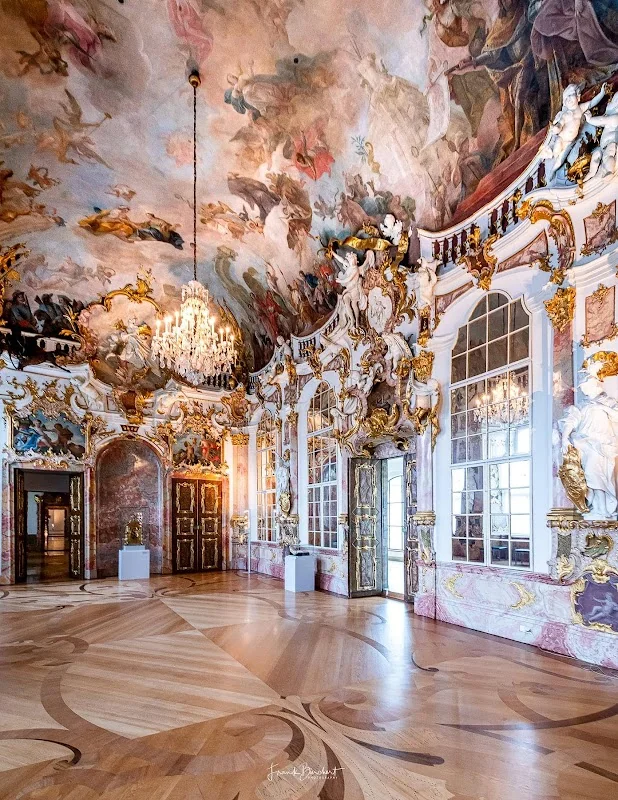
The Residence Kempten is one of the outstanding architectural monuments of Baroque in Germany. After the destruction of the Benedictine monastery founded around 750 during the Thirty Years' War, the young prince abbot Roman Giel von Gielsberg had the church and residence rebuilt on a monumental scale starting in 1651 – as the first large baroque monastery complex in Germany after the end of the war. The Vorarlberg master builder Michael Beer was initially entrusted with the grand project; when he left at the end of 1653, the west wing was completed. In 1654, Johann Serro from Graubünden took over and completed the complex by 1670, including the connecting sacristy extension between the church and residence. The furnishings of the prince abbots' living quarters – the state rooms visited today – were created later, between 1732 and 1742, under Prince Abbot Anselm von Reichlin-Meldegg. A high-caliber ensemble of artists shaped the style: The painter Franz Georg Hermann was responsible for the iconographic design as artistic director; the sculptures were created by Aegid Verhelst; the stucco comes from Johann Georg Üblher. The sequence of rooms corresponds to the courtly canon of the 18th century: festival hall, anteroom, audience room, living room, bedroom; instead of the usually following cabinet, there is the court chancellery here. The highlight is considered to be the decoration of the festival or throne room in the years 1740–1742, presumably based on a design by Dominikus Zimmermann – a masterpiece of Bavarian Rococo. Its architecture, spanning two floors, is subtly structured; figure stucco and rich decor create a festive, bright effect. The barrel vault is adorned with a large-format ceiling painting by Franz Georg Hermann, which thematizes the glorification of the prince abbey and its history. A special feature of the state rooms is the conscious integration of sacred architectural and decorative elements into princely living spaces, combined with a warm, cheerful color scheme – a mixture that gives the residence its unmistakable atmosphere. Today, the building, as the “residential building,” houses the district court and the local court of Kempten; the state rooms are managed by the Bavarian Administration of State Palaces, Gardens, and Lakes and are accessible as part of guided tours.
What You Experience in the State Rooms: Room Sequence, Ceiling Paintings, and Rococo Splendor
The tour through the state rooms conveys a vivid picture of baroque representation culture. Even the way through the anterooms makes it clear how carefully rank, ceremony, and public self-presentation of the prince abbots were orchestrated. In the audience room, court etiquette and visual messages condense in portraits, allegorical paintings, and sculptures. The living room and bedroom show the private sphere – albeit in a representative form. The special dramaturgy reaches its peak in the festival/throne room: Over five window axes and two floors opens a space that impresses with rhythmically structured pilasters, lavish stucco cartouches, and finely modeled figure stuccos. The ceiling painting by Franz Georg Hermann spans a narrative panorama over the history of the prince abbey; its composition directs the gaze upward and creates the impression of a bright, open sky. Recurring motifs – putti, coats of arms, floral ornaments – form a visual leitmotif that binds the rooms together. Those who look closely will discover the specific character of the Kempten residence: Sacred elements such as altar motifs or liturgically inspired decorative elements are integrated into the princely living spaces – a conscious aesthetic decision that emphasizes the spiritual authority of the prince abbot. The warm, strong colors convey closeness and coziness; they distinguish the rooms from cooler, purely courtly interiors. Practically: To protect the historic floor, visitors wear felt slippers – a small gesture with a big effect, as it preserves the original parquet for future generations. The guides incorporate these details into their explanations, establish connections to the building history and the relationship between the residence and the abbey church, and explain why the festival hall in Kempten is considered the highlight of Bavarian Rococo. This creates a coherent overall picture that connects art, history, and the everyday life of the prince abbots.
Accessibility, Families, and Service: Comfortable Visit
Good conditions make the visit to the residence comfortable – for families, groups, and people with limited mobility. An elevator provides barrier-free access to the state rooms; signage safely guides visitors through the building. To protect the sensitive wooden floors, felt slippers are provided, which are worn when entering the rooms. Families benefit from the generous conditions: Children and teenagers up to 18 years visit the state rooms free of charge, making the joint cultural outing affordable. For groups, special appointments can be organized upon request; the regular tour intervals also facilitate planning. Those who value quieter moments choose off-peak times – for example, early in the morning outside of holidays. Important to know: For conservation reasons, animals are not allowed in the state rooms. During the Kempten Christmas market, additional tour times are offered; this makes a winter combination of market visit and cultural program possible. The central location at Residence Square allows visitors to combine their visit with other highlights: The court garden with the orangery invites for a walk; nearby cafes and restaurants offer opportunities for refreshments. For in-depth city history, the Kempten Museum in Zumsteinhaus (free admission) is just a few minutes' walk away. Those planning to arrive by public transport can reach the residence via the stop “Center”; drivers will find barrier-free parking spaces and elevators in the mentioned underground garages. For organizational questions – such as group tours or special needs – it is worthwhile to contact the contacts provided in the visitor information in advance. This ensures a smooth, inspiring cultural experience.
Events in the Courtyard and Court Garden Hall: Culture in the Open Air and Historical Setting
In addition to the tours through the state rooms, the residence is also an active cultural venue. The courtyard – surrounded by the facades of the baroque complex – provides an atmospheric backdrop for concerts and special programs. Acoustics and ambiance create a special flair that clearly distinguishes the events from classical hall formats. Inside, the court garden hall opens up additional possibilities: It can be rented for private or business events and regularly serves as an exhibition and cultural space. A recurring highlight is the art exhibition as part of the Allgäu Festival Week, which has been showcasing regional art for decades and takes place in the court garden hall – with public tours and artist talks. Due to its central location at Residence Square, accessibility is excellent; nearby gastronomy and the walkable city center infrastructure facilitate the planning of accompanying program points. Those planning an event benefit from the historical setting without sacrificing urban connectivity. The official tourism information points out the possibility of renting the court garden hall; inquiries can be made via email through the provided contacts. Even beyond the festival week, formats such as chamber concerts, readings, or panels take place. This creates a lively dialogue between monument preservation and contemporary culture – the residence remains not only a preserved past but also a stage for today's encounters. For the visit, it is advisable to check the city's event program in advance and – depending on the weather and season – plan enough time for a detour to the court garden. For open-air events, an earlier arrival is advisable due to limited seating or standing places; as an alternative, the court garden hall offers weather-independent capacities.
Context and Present: Court Operations in the Residence Building – Culture in the State Rooms
A distinctive feature of the Kempten residence is its dual use: The residence building is now home to the district court and local court of Kempten; at the same time, the historic state rooms are managed by the Bavarian Administration of State Palaces, Gardens, and Lakes and are opened for visitors. This combination explains why visits are only possible as guided tours and take place at set times: It ensures the protection of the rooms and coordinates visitor flow in the context of an active administrative and court location. For guests, this is an advantage: The tours offer compact, knowledgeable access, and questions about building history, image programs, or furnishings can be directly addressed. Those interested in legal history or the institutions of Bavarian justice gain impressions of today's court routine on the side – of course, separated from the museum-accessed areas. The clear pathways, security regulations, and accessibility information of the courts help with orientation. For those planning cultural events, the court garden hall is the suitable address within the complex; it operates independently of court operations. In the interplay of past and present, an urban ensemble emerges: baroque architecture, historic garden, vibrant city, modern infrastructure. All of this makes the Residence Kempten an ideal focal point for Allgäu travelers, school trips, culture and architecture enthusiasts – and for locals who want to rediscover their urban space.
Sources:
- Bavarian Palace Administration – Residence Kempten (official site)
- Kempten Tourism – State Rooms of the Residence
- District Court Kempten – Contact & Address
- B+B Parking Garage – Underground Garage Königsplatz Kempten
- Parking Space Worlds – Parking Garage Fasshalle Kempten
- Allgäu – Art Exhibition in the Court Garden Hall (City of Kempten, Dates 2025)
Show moreShow less
Residence Kempten | Tours & Opening Hours
The residence in Kempten (Allgäu) is considered one of the most significant baroque sites in southern Germany. Located directly at the Residence Square, the state rooms offer a vivid glimpse into the time of the prince abbots – with refined sequences of rooms, lavish stuccos, and a festival hall celebrated as the highlight of Bavarian Rococo. Today, visitors to the residence experience history not as a dry chronicle, but as a carefully curated tour: Visits are only possible as part of guided tours, which start at short intervals throughout the day. Families appreciate the fair admission prices and the central location, while cultural travelers enjoy the unique combination of sacred and courtly splendor. Thanks to an elevator, access to the state rooms is barrier-free; felt slippers are used to protect the historic parquet. Public transport and nearby parking garages are available for arrival – ideal for combining a visit to the residence with a city stroll, the court garden, or a museum visit.
Tours, Tickets, and Opening Hours: Plan Your Visit
Access to the state rooms of the Residence Kempten is exclusively possible within the framework of guided tours. These start at regular intervals of 45 minutes, keeping waiting times manageable and providing each group with a supervised, focused experience. The last tour of the day begins at 4:00 PM, so it is advisable to arrive by early afternoon at the latest. Seasonal opening hours structure the year: From April to October, the state rooms are accessible from Tuesday to Sunday from 10:00 AM to 4:00 PM; closed on Mondays, except for Easter Monday and Whit Monday. In the winter months from November to March, tours are available on weekends (Saturday and Sunday) between 10:00 AM and 4:00 PM. A special feature is the timing during the Kempten Christmas market: Daily tours take place between 12:15 PM and 4:00 PM – perfect for combining cultural and Advent flair. Tickets are sold exclusively on-site. The prices are visitor-friendly: In 2025, regular admission costs 4 euros, reduced 3 euros; children and teenagers up to the age of 18 receive free admission. Group tours can be organized upon request; contacts are the local tourism and cultural offices mentioned in the official visitor information. The tours are conducted in German; for foreign language groups, it is worthwhile to inquire in advance. Informative accompanying texts and the expertise of the guides make the tour accessible even without prior knowledge. Tip: Plan some buffer time before the last tour to have enough time for ticket purchase, cloakroom, and putting on the felt slippers. If you are flexible, choose a morning appointment; visitor numbers are often more relaxed then, and the view of the ceiling painting can be enjoyed in peace. If you are traveling with children, the manageable tour intervals are ideal – short waiting times, clear dramaturgy, many visually striking objects. Even in the off-season, a visit is worthwhile: The concentrated winter light and the calm atmosphere make the details of the stuccos particularly impressive.
Access and Parking: Residence Square, Bus “Center” and Underground Garages within Walking Distance
The address of the residence is Residence Square 4–6, 87435 Kempten (Allgäu) – right in the historic city center and just a few steps from the court garden. Those arriving by public transport can use the bus lines to the stop “Center.” From there, you can reach the entrance of the residence on foot in a few minutes. For those arriving by car, the official visitor information recommends the underground garage at Königsplatz. It is centrally located, offers numerous parking spaces, and is designed for city traffic. According to operator information, hundreds of parking spaces are available here; the entrance height is about 2.10 m. Typically, the underground garage is open on weekdays from morning until evening, and exit is generally possible around the clock; the rates are time-dependent with daily maxima. Alternatively, the parking garage Fasshalle at Königstraße 8 is available. It is open continuously (24/7) and features simple pricing: The operator charges 0.60 € for every started 30 minutes and 9.00 € for a 24-hour rate (as of the last publication). Both garages are within walking distance of the residence and also serve as a good starting point for a city stroll. Those wishing to park barrier-free will find designated spaces and elevators in the large parking garages. For visitors from outside, arriving in Kempten is easy via the train connections of Deutsche Bahn; from the train station, you can take the city buses to the city center. For navigation devices, entering “Residence Square 4–6” reliably leads to the destination. During events in the courtyard of the residence, the surroundings may be busier; plan for a bit more time for parking search or use the alternative garage.
History and Highlights: The First Monumental Baroque Monastery Complex After the Thirty Years' War
The Residence Kempten is one of the outstanding architectural monuments of Baroque in Germany. After the destruction of the Benedictine monastery founded around 750 during the Thirty Years' War, the young prince abbot Roman Giel von Gielsberg had the church and residence rebuilt on a monumental scale starting in 1651 – as the first large baroque monastery complex in Germany after the end of the war. The Vorarlberg master builder Michael Beer was initially entrusted with the grand project; when he left at the end of 1653, the west wing was completed. In 1654, Johann Serro from Graubünden took over and completed the complex by 1670, including the connecting sacristy extension between the church and residence. The furnishings of the prince abbots' living quarters – the state rooms visited today – were created later, between 1732 and 1742, under Prince Abbot Anselm von Reichlin-Meldegg. A high-caliber ensemble of artists shaped the style: The painter Franz Georg Hermann was responsible for the iconographic design as artistic director; the sculptures were created by Aegid Verhelst; the stucco comes from Johann Georg Üblher. The sequence of rooms corresponds to the courtly canon of the 18th century: festival hall, anteroom, audience room, living room, bedroom; instead of the usually following cabinet, there is the court chancellery here. The highlight is considered to be the decoration of the festival or throne room in the years 1740–1742, presumably based on a design by Dominikus Zimmermann – a masterpiece of Bavarian Rococo. Its architecture, spanning two floors, is subtly structured; figure stucco and rich decor create a festive, bright effect. The barrel vault is adorned with a large-format ceiling painting by Franz Georg Hermann, which thematizes the glorification of the prince abbey and its history. A special feature of the state rooms is the conscious integration of sacred architectural and decorative elements into princely living spaces, combined with a warm, cheerful color scheme – a mixture that gives the residence its unmistakable atmosphere. Today, the building, as the “residential building,” houses the district court and the local court of Kempten; the state rooms are managed by the Bavarian Administration of State Palaces, Gardens, and Lakes and are accessible as part of guided tours.
What You Experience in the State Rooms: Room Sequence, Ceiling Paintings, and Rococo Splendor
The tour through the state rooms conveys a vivid picture of baroque representation culture. Even the way through the anterooms makes it clear how carefully rank, ceremony, and public self-presentation of the prince abbots were orchestrated. In the audience room, court etiquette and visual messages condense in portraits, allegorical paintings, and sculptures. The living room and bedroom show the private sphere – albeit in a representative form. The special dramaturgy reaches its peak in the festival/throne room: Over five window axes and two floors opens a space that impresses with rhythmically structured pilasters, lavish stucco cartouches, and finely modeled figure stuccos. The ceiling painting by Franz Georg Hermann spans a narrative panorama over the history of the prince abbey; its composition directs the gaze upward and creates the impression of a bright, open sky. Recurring motifs – putti, coats of arms, floral ornaments – form a visual leitmotif that binds the rooms together. Those who look closely will discover the specific character of the Kempten residence: Sacred elements such as altar motifs or liturgically inspired decorative elements are integrated into the princely living spaces – a conscious aesthetic decision that emphasizes the spiritual authority of the prince abbot. The warm, strong colors convey closeness and coziness; they distinguish the rooms from cooler, purely courtly interiors. Practically: To protect the historic floor, visitors wear felt slippers – a small gesture with a big effect, as it preserves the original parquet for future generations. The guides incorporate these details into their explanations, establish connections to the building history and the relationship between the residence and the abbey church, and explain why the festival hall in Kempten is considered the highlight of Bavarian Rococo. This creates a coherent overall picture that connects art, history, and the everyday life of the prince abbots.
Accessibility, Families, and Service: Comfortable Visit
Good conditions make the visit to the residence comfortable – for families, groups, and people with limited mobility. An elevator provides barrier-free access to the state rooms; signage safely guides visitors through the building. To protect the sensitive wooden floors, felt slippers are provided, which are worn when entering the rooms. Families benefit from the generous conditions: Children and teenagers up to 18 years visit the state rooms free of charge, making the joint cultural outing affordable. For groups, special appointments can be organized upon request; the regular tour intervals also facilitate planning. Those who value quieter moments choose off-peak times – for example, early in the morning outside of holidays. Important to know: For conservation reasons, animals are not allowed in the state rooms. During the Kempten Christmas market, additional tour times are offered; this makes a winter combination of market visit and cultural program possible. The central location at Residence Square allows visitors to combine their visit with other highlights: The court garden with the orangery invites for a walk; nearby cafes and restaurants offer opportunities for refreshments. For in-depth city history, the Kempten Museum in Zumsteinhaus (free admission) is just a few minutes' walk away. Those planning to arrive by public transport can reach the residence via the stop “Center”; drivers will find barrier-free parking spaces and elevators in the mentioned underground garages. For organizational questions – such as group tours or special needs – it is worthwhile to contact the contacts provided in the visitor information in advance. This ensures a smooth, inspiring cultural experience.
Events in the Courtyard and Court Garden Hall: Culture in the Open Air and Historical Setting
In addition to the tours through the state rooms, the residence is also an active cultural venue. The courtyard – surrounded by the facades of the baroque complex – provides an atmospheric backdrop for concerts and special programs. Acoustics and ambiance create a special flair that clearly distinguishes the events from classical hall formats. Inside, the court garden hall opens up additional possibilities: It can be rented for private or business events and regularly serves as an exhibition and cultural space. A recurring highlight is the art exhibition as part of the Allgäu Festival Week, which has been showcasing regional art for decades and takes place in the court garden hall – with public tours and artist talks. Due to its central location at Residence Square, accessibility is excellent; nearby gastronomy and the walkable city center infrastructure facilitate the planning of accompanying program points. Those planning an event benefit from the historical setting without sacrificing urban connectivity. The official tourism information points out the possibility of renting the court garden hall; inquiries can be made via email through the provided contacts. Even beyond the festival week, formats such as chamber concerts, readings, or panels take place. This creates a lively dialogue between monument preservation and contemporary culture – the residence remains not only a preserved past but also a stage for today's encounters. For the visit, it is advisable to check the city's event program in advance and – depending on the weather and season – plan enough time for a detour to the court garden. For open-air events, an earlier arrival is advisable due to limited seating or standing places; as an alternative, the court garden hall offers weather-independent capacities.
Context and Present: Court Operations in the Residence Building – Culture in the State Rooms
A distinctive feature of the Kempten residence is its dual use: The residence building is now home to the district court and local court of Kempten; at the same time, the historic state rooms are managed by the Bavarian Administration of State Palaces, Gardens, and Lakes and are opened for visitors. This combination explains why visits are only possible as guided tours and take place at set times: It ensures the protection of the rooms and coordinates visitor flow in the context of an active administrative and court location. For guests, this is an advantage: The tours offer compact, knowledgeable access, and questions about building history, image programs, or furnishings can be directly addressed. Those interested in legal history or the institutions of Bavarian justice gain impressions of today's court routine on the side – of course, separated from the museum-accessed areas. The clear pathways, security regulations, and accessibility information of the courts help with orientation. For those planning cultural events, the court garden hall is the suitable address within the complex; it operates independently of court operations. In the interplay of past and present, an urban ensemble emerges: baroque architecture, historic garden, vibrant city, modern infrastructure. All of this makes the Residence Kempten an ideal focal point for Allgäu travelers, school trips, culture and architecture enthusiasts – and for locals who want to rediscover their urban space.
Sources:
- Bavarian Palace Administration – Residence Kempten (official site)
- Kempten Tourism – State Rooms of the Residence
- District Court Kempten – Contact & Address
- B+B Parking Garage – Underground Garage Königsplatz Kempten
- Parking Space Worlds – Parking Garage Fasshalle Kempten
- Allgäu – Art Exhibition in the Court Garden Hall (City of Kempten, Dates 2025)
Residence Kempten | Tours & Opening Hours
The residence in Kempten (Allgäu) is considered one of the most significant baroque sites in southern Germany. Located directly at the Residence Square, the state rooms offer a vivid glimpse into the time of the prince abbots – with refined sequences of rooms, lavish stuccos, and a festival hall celebrated as the highlight of Bavarian Rococo. Today, visitors to the residence experience history not as a dry chronicle, but as a carefully curated tour: Visits are only possible as part of guided tours, which start at short intervals throughout the day. Families appreciate the fair admission prices and the central location, while cultural travelers enjoy the unique combination of sacred and courtly splendor. Thanks to an elevator, access to the state rooms is barrier-free; felt slippers are used to protect the historic parquet. Public transport and nearby parking garages are available for arrival – ideal for combining a visit to the residence with a city stroll, the court garden, or a museum visit.
Tours, Tickets, and Opening Hours: Plan Your Visit
Access to the state rooms of the Residence Kempten is exclusively possible within the framework of guided tours. These start at regular intervals of 45 minutes, keeping waiting times manageable and providing each group with a supervised, focused experience. The last tour of the day begins at 4:00 PM, so it is advisable to arrive by early afternoon at the latest. Seasonal opening hours structure the year: From April to October, the state rooms are accessible from Tuesday to Sunday from 10:00 AM to 4:00 PM; closed on Mondays, except for Easter Monday and Whit Monday. In the winter months from November to March, tours are available on weekends (Saturday and Sunday) between 10:00 AM and 4:00 PM. A special feature is the timing during the Kempten Christmas market: Daily tours take place between 12:15 PM and 4:00 PM – perfect for combining cultural and Advent flair. Tickets are sold exclusively on-site. The prices are visitor-friendly: In 2025, regular admission costs 4 euros, reduced 3 euros; children and teenagers up to the age of 18 receive free admission. Group tours can be organized upon request; contacts are the local tourism and cultural offices mentioned in the official visitor information. The tours are conducted in German; for foreign language groups, it is worthwhile to inquire in advance. Informative accompanying texts and the expertise of the guides make the tour accessible even without prior knowledge. Tip: Plan some buffer time before the last tour to have enough time for ticket purchase, cloakroom, and putting on the felt slippers. If you are flexible, choose a morning appointment; visitor numbers are often more relaxed then, and the view of the ceiling painting can be enjoyed in peace. If you are traveling with children, the manageable tour intervals are ideal – short waiting times, clear dramaturgy, many visually striking objects. Even in the off-season, a visit is worthwhile: The concentrated winter light and the calm atmosphere make the details of the stuccos particularly impressive.
Access and Parking: Residence Square, Bus “Center” and Underground Garages within Walking Distance
The address of the residence is Residence Square 4–6, 87435 Kempten (Allgäu) – right in the historic city center and just a few steps from the court garden. Those arriving by public transport can use the bus lines to the stop “Center.” From there, you can reach the entrance of the residence on foot in a few minutes. For those arriving by car, the official visitor information recommends the underground garage at Königsplatz. It is centrally located, offers numerous parking spaces, and is designed for city traffic. According to operator information, hundreds of parking spaces are available here; the entrance height is about 2.10 m. Typically, the underground garage is open on weekdays from morning until evening, and exit is generally possible around the clock; the rates are time-dependent with daily maxima. Alternatively, the parking garage Fasshalle at Königstraße 8 is available. It is open continuously (24/7) and features simple pricing: The operator charges 0.60 € for every started 30 minutes and 9.00 € for a 24-hour rate (as of the last publication). Both garages are within walking distance of the residence and also serve as a good starting point for a city stroll. Those wishing to park barrier-free will find designated spaces and elevators in the large parking garages. For visitors from outside, arriving in Kempten is easy via the train connections of Deutsche Bahn; from the train station, you can take the city buses to the city center. For navigation devices, entering “Residence Square 4–6” reliably leads to the destination. During events in the courtyard of the residence, the surroundings may be busier; plan for a bit more time for parking search or use the alternative garage.
History and Highlights: The First Monumental Baroque Monastery Complex After the Thirty Years' War
The Residence Kempten is one of the outstanding architectural monuments of Baroque in Germany. After the destruction of the Benedictine monastery founded around 750 during the Thirty Years' War, the young prince abbot Roman Giel von Gielsberg had the church and residence rebuilt on a monumental scale starting in 1651 – as the first large baroque monastery complex in Germany after the end of the war. The Vorarlberg master builder Michael Beer was initially entrusted with the grand project; when he left at the end of 1653, the west wing was completed. In 1654, Johann Serro from Graubünden took over and completed the complex by 1670, including the connecting sacristy extension between the church and residence. The furnishings of the prince abbots' living quarters – the state rooms visited today – were created later, between 1732 and 1742, under Prince Abbot Anselm von Reichlin-Meldegg. A high-caliber ensemble of artists shaped the style: The painter Franz Georg Hermann was responsible for the iconographic design as artistic director; the sculptures were created by Aegid Verhelst; the stucco comes from Johann Georg Üblher. The sequence of rooms corresponds to the courtly canon of the 18th century: festival hall, anteroom, audience room, living room, bedroom; instead of the usually following cabinet, there is the court chancellery here. The highlight is considered to be the decoration of the festival or throne room in the years 1740–1742, presumably based on a design by Dominikus Zimmermann – a masterpiece of Bavarian Rococo. Its architecture, spanning two floors, is subtly structured; figure stucco and rich decor create a festive, bright effect. The barrel vault is adorned with a large-format ceiling painting by Franz Georg Hermann, which thematizes the glorification of the prince abbey and its history. A special feature of the state rooms is the conscious integration of sacred architectural and decorative elements into princely living spaces, combined with a warm, cheerful color scheme – a mixture that gives the residence its unmistakable atmosphere. Today, the building, as the “residential building,” houses the district court and the local court of Kempten; the state rooms are managed by the Bavarian Administration of State Palaces, Gardens, and Lakes and are accessible as part of guided tours.
What You Experience in the State Rooms: Room Sequence, Ceiling Paintings, and Rococo Splendor
The tour through the state rooms conveys a vivid picture of baroque representation culture. Even the way through the anterooms makes it clear how carefully rank, ceremony, and public self-presentation of the prince abbots were orchestrated. In the audience room, court etiquette and visual messages condense in portraits, allegorical paintings, and sculptures. The living room and bedroom show the private sphere – albeit in a representative form. The special dramaturgy reaches its peak in the festival/throne room: Over five window axes and two floors opens a space that impresses with rhythmically structured pilasters, lavish stucco cartouches, and finely modeled figure stuccos. The ceiling painting by Franz Georg Hermann spans a narrative panorama over the history of the prince abbey; its composition directs the gaze upward and creates the impression of a bright, open sky. Recurring motifs – putti, coats of arms, floral ornaments – form a visual leitmotif that binds the rooms together. Those who look closely will discover the specific character of the Kempten residence: Sacred elements such as altar motifs or liturgically inspired decorative elements are integrated into the princely living spaces – a conscious aesthetic decision that emphasizes the spiritual authority of the prince abbot. The warm, strong colors convey closeness and coziness; they distinguish the rooms from cooler, purely courtly interiors. Practically: To protect the historic floor, visitors wear felt slippers – a small gesture with a big effect, as it preserves the original parquet for future generations. The guides incorporate these details into their explanations, establish connections to the building history and the relationship between the residence and the abbey church, and explain why the festival hall in Kempten is considered the highlight of Bavarian Rococo. This creates a coherent overall picture that connects art, history, and the everyday life of the prince abbots.
Accessibility, Families, and Service: Comfortable Visit
Good conditions make the visit to the residence comfortable – for families, groups, and people with limited mobility. An elevator provides barrier-free access to the state rooms; signage safely guides visitors through the building. To protect the sensitive wooden floors, felt slippers are provided, which are worn when entering the rooms. Families benefit from the generous conditions: Children and teenagers up to 18 years visit the state rooms free of charge, making the joint cultural outing affordable. For groups, special appointments can be organized upon request; the regular tour intervals also facilitate planning. Those who value quieter moments choose off-peak times – for example, early in the morning outside of holidays. Important to know: For conservation reasons, animals are not allowed in the state rooms. During the Kempten Christmas market, additional tour times are offered; this makes a winter combination of market visit and cultural program possible. The central location at Residence Square allows visitors to combine their visit with other highlights: The court garden with the orangery invites for a walk; nearby cafes and restaurants offer opportunities for refreshments. For in-depth city history, the Kempten Museum in Zumsteinhaus (free admission) is just a few minutes' walk away. Those planning to arrive by public transport can reach the residence via the stop “Center”; drivers will find barrier-free parking spaces and elevators in the mentioned underground garages. For organizational questions – such as group tours or special needs – it is worthwhile to contact the contacts provided in the visitor information in advance. This ensures a smooth, inspiring cultural experience.
Events in the Courtyard and Court Garden Hall: Culture in the Open Air and Historical Setting
In addition to the tours through the state rooms, the residence is also an active cultural venue. The courtyard – surrounded by the facades of the baroque complex – provides an atmospheric backdrop for concerts and special programs. Acoustics and ambiance create a special flair that clearly distinguishes the events from classical hall formats. Inside, the court garden hall opens up additional possibilities: It can be rented for private or business events and regularly serves as an exhibition and cultural space. A recurring highlight is the art exhibition as part of the Allgäu Festival Week, which has been showcasing regional art for decades and takes place in the court garden hall – with public tours and artist talks. Due to its central location at Residence Square, accessibility is excellent; nearby gastronomy and the walkable city center infrastructure facilitate the planning of accompanying program points. Those planning an event benefit from the historical setting without sacrificing urban connectivity. The official tourism information points out the possibility of renting the court garden hall; inquiries can be made via email through the provided contacts. Even beyond the festival week, formats such as chamber concerts, readings, or panels take place. This creates a lively dialogue between monument preservation and contemporary culture – the residence remains not only a preserved past but also a stage for today's encounters. For the visit, it is advisable to check the city's event program in advance and – depending on the weather and season – plan enough time for a detour to the court garden. For open-air events, an earlier arrival is advisable due to limited seating or standing places; as an alternative, the court garden hall offers weather-independent capacities.
Context and Present: Court Operations in the Residence Building – Culture in the State Rooms
A distinctive feature of the Kempten residence is its dual use: The residence building is now home to the district court and local court of Kempten; at the same time, the historic state rooms are managed by the Bavarian Administration of State Palaces, Gardens, and Lakes and are opened for visitors. This combination explains why visits are only possible as guided tours and take place at set times: It ensures the protection of the rooms and coordinates visitor flow in the context of an active administrative and court location. For guests, this is an advantage: The tours offer compact, knowledgeable access, and questions about building history, image programs, or furnishings can be directly addressed. Those interested in legal history or the institutions of Bavarian justice gain impressions of today's court routine on the side – of course, separated from the museum-accessed areas. The clear pathways, security regulations, and accessibility information of the courts help with orientation. For those planning cultural events, the court garden hall is the suitable address within the complex; it operates independently of court operations. In the interplay of past and present, an urban ensemble emerges: baroque architecture, historic garden, vibrant city, modern infrastructure. All of this makes the Residence Kempten an ideal focal point for Allgäu travelers, school trips, culture and architecture enthusiasts – and for locals who want to rediscover their urban space.
Sources:
- Bavarian Palace Administration – Residence Kempten (official site)
- Kempten Tourism – State Rooms of the Residence
- District Court Kempten – Contact & Address
- B+B Parking Garage – Underground Garage Königsplatz Kempten
- Parking Space Worlds – Parking Garage Fasshalle Kempten
- Allgäu – Art Exhibition in the Court Garden Hall (City of Kempten, Dates 2025)
Upcoming Events

Frequently Asked Questions
Reviews
Thomas
31. August 2025
During our city tour of Kempten, we also visited the Residence. The entrance area and the staircase seem a bit plain and old-fashioned, but from the first floor onwards, a completely different picture unfolds: The magnificent Baroque rooms are impressively designed and provide an excellent insight into the art and architecture of that time. Many details are vividly explained, allowing you to truly experience the history. Absolutely worth seeing – a highlight in Kempten!
Heino Gilmer
18. October 2025
Very worth seeing. However, we were lucky to get a VIP tour. Very interesting and impressive, even though only a few rooms are open for viewing. But our guide was very nice and informative. I can only recommend it.
Tina
8. June 2025
The Residence is used by the judiciary as an administrative building. A few rooms can be visited through a tour where court cases were held and offices were located until 30 years ago. Now, they are partially accessible to the public. The tours start every 45 minutes on time and cost only €4 per person. Our guide was very knowledgeable and provided us with extensive information about the significance of the rooms and paintings, plus a singing performance! We really enjoyed it.
Großekleine Bärliner
26. August 2025
Beautiful residence, great tour. Beautiful rooms are shown with expert explanations, costing €4, it's worth it.
Marina Popovic
9. June 2025
Beautiful! The tour was also very interesting and exciting. Admission for children is free and for adults €4. Clear recommendation!