
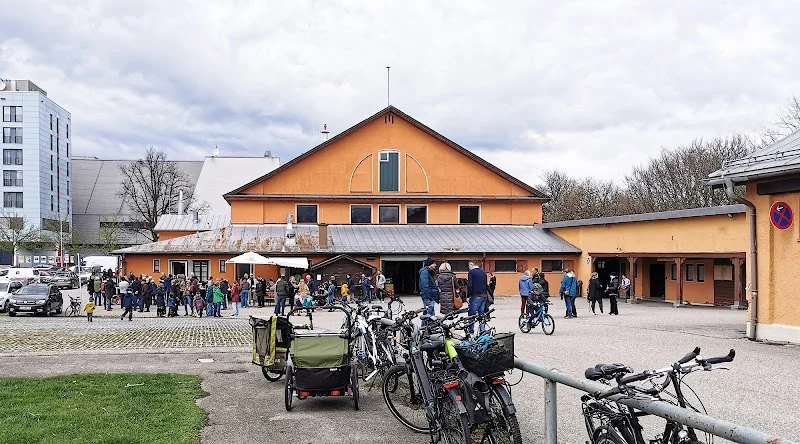
Kotterner Str. 54, Kempten (Allgäu)
Kotterner Str. 54, 87435 Kempten (Allgäu), Germany
Cultural Economy in the Allgäuhalle | Program & Events
The Cultural Economy in the Allgäuhalle is one of those places where Kempten presents itself in a very immediate, personal, and surprising way: not as an anonymous large area, but as a vibrant cultural space with history, attitude, and a clear program. Since April 2023, the Cultural Quarter Allgäu e.V. has been operating the former restaurant of the Allgäuhalle on a voluntary basis as a live club and small arts stage. The special aspect lies not only in the cultural offerings but also in the place itself: The Allgäuhalle was built in 1928, served as an external camp of a concentration camp from 1943 to 1945 in the history of the site, has been a listed building since 2015, and still visibly carries the layers of its past. This is precisely what creates the special atmosphere that attracts many visitors: a historical building that is not museum-like but is filled with life again in everyday life. The Cultural Economy connects concerts, readings, comedy, dance evenings, participatory formats, and social encounters into a place that is culturally accessible while being clearly positioned in content. Those looking for culture in Kempten, a cultural house, a cultural hall, or a special location in the Allgäu will find a place that is locally rooted and thematically surprisingly broad here. ([kulturquartier-allgaeu.de](https://kulturquartier-allgaeu.de/))
Events, Program, and Open Stage in the Cultural Economy
The program of the Cultural Economy is deliberately diverse, and this is reflected in the search queries: People search for programs, open mics, comedy, cabaret, concert dates, or individual events like tango, quizzes, or metal. The official program page shows that the Cultural Economy does not function as a one-topic stage but as an open place for various cultural milieus. This is particularly evident at the Open Stage of artig e.V., which has found its new home on the stage of the Cultural Economy since 2023. The format invites spontaneous performances with texts, songs, dance, pantomime, or band contributions; pre-registration is not required, entry and start times are clearly regulated, and admission is free. The Comedy Open Mic evening follows this idea: Here, newcomers and experienced comedians test new material, positioning the Cultural Economy as an experimental place for vibrant stage culture. Additionally, formats like karaoke evenings, where anyone can perform alone, in pairs, or in a choir, as well as open social meeting points like the Kartel evening, which aims to promote intergenerational interaction, are included. This mix of stage, tavern proximity, and participatory culture is rare in Kempten and explains why many users are not only looking for a single event but for the overall experience. ([kulturquartier-allgaeu.de](https://kulturquartier-allgaeu.de/open-stage-dein-mikro-deine-buehne-dein-publikum-2025-10-17))
Moreover, the Cultural Economy is also used for recurring, almost ritualized formats. According to the event page, the quiz evening usually takes place monthly, the Schafkopf evening as a neighborhood gathering regularly on the last Tuesday of the month, and the Market Economy complements the events with a monthly flea market moment and homemade Allgäu cheese noodles. This shows: It is not only about concerts but about a culture of in-between, about conversation, encounters, and recurring community. At the same time, the spectrum goes far beyond the regulars' table character. The program features readings, tango evenings, children's jazz, singer-songwriter performances, rock and metal concerts, as well as festival-like daytime formats. The official page for the one-year anniversary of the Cultural Economy documents, for example, a daytime program with face painting, a bouncy castle, brass music, children's theater, singer-songwriters, improvisational theater, hip-hop, and garage psych rock. This range makes the place relevant for very different target groups: for culture fans, families, music lovers, scene audiences, and people simply looking for an accessible evening in an independent location. Therefore, when search queries for Cultural Economy Kempten, Cultural Economy Allgäuhalle Kempten, or specific event names arise, it is usually not about a single category but about the diverse overall program of a place that has consciously remained open. ([kulturquartier-allgaeu.de](https://kulturquartier-allgaeu.de/9-kqa-quizabend-2025-05-28?utm_source=openai))
Allgäuhalle in Kempten: History, Monument Protection, and Memory
The historical depth of the Allgäuhalle is a central part of its identity and explains why the location is much more than just an event space. According to official pages, the hall was built in 1928 for the trade of breeding cattle. The building complex consists of the Allgäuhalle and the calf hall; both parts are under ensemble protection, and the Allgäuhalle is additionally under monument protection. This is crucial for today's use because it restricts structural interventions on the outer shell and preserves the historical character of the site. At the same time, the building carries a complex past: The homepage of the Cultural Quarter Allgäu e.V. explicitly mentions that the hall was used by the Nazi regime as an external camp between 1943 and 1945. Therefore, when talking about the Cultural Economy, one is always also talking about memory culture, careful usage, and the question of how a burdened place can be responsibly revitalized in the present. This is where the project positions itself: not as a repression of history but as a conscious engagement with it. The place thus remains not only culturally visible but also historically readable. ([kulturquartier-allgaeu.de](https://kulturquartier-allgaeu.de/news/news/die-geschichte-der-allgaeuhalle-ch4air))
The Cultural Quarter Allgäu e.V. pursues a clearly formulated goal. On the site of the Allgäuhalle, which extends over approximately 11,000 square meters directly in the city center, a cultural quarter with stages, rehearsal rooms, studios, and other cultural uses is to be created. The project sees the Cultural Economy as the first step in this direction. The official page describes that since 2021, an association and an initiative have been working towards this goal, and the halls are envisioned as a potential first cultural center in Kempten. This development is also exciting from a city history perspective, as it shows how a former utility building from agriculture can be transformed into an urban cultural center without denying its origins. At the same time, the pages emphasize that the hall is located on the edge of the city center, within walking distance to the train station and university, and is thus not only historically but also urbanistically well integrated. This is particularly relevant for search queries like cultural house Kempten, cultural hall Kempten, or culture Allgäu: A place is evidently being sought that combines historical identity, urban location, and cultural presence. The Cultural Economy in the Allgäuhalle achieves exactly this by not overwriting the old infrastructure but filling it with new content. ([kulturquartier-allgaeu.de](https://kulturquartier-allgaeu.de/der-verein/ueber-uns?utm_source=openai))
Access, Parking, and Location on the Edge of the City Center
For visitors, the location of the Cultural Economy is extremely practical because it is central yet easily accessible. The official history page describes the hall as being located on the edge of Kempten's city center, within walking distance to the train station and university, and immediately next to a large parking lot. This large parking lot is crucial for many event visits because it facilitates arrival by car and makes the place easily reachable in everyday life. The location at Kotterner Straße 54 is also a clear advantage, as it is easily identifiable within the Kempten city structure and is near other large facilities. For users searching for parking, access, or seating plans, this is an important signal: The Cultural Economy is not a hidden backyard stage but a cultural place with a visible, functional address. The proximity to the train station and university also speaks for good accessibility by public transport or on foot, which is particularly practical for evening events and open stage formats. ([kulturquartier-allgaeu.de](https://kulturquartier-allgaeu.de/news/news/die-geschichte-der-allgaeuhalle-ch4air))
Additionally, the access and parking page of bigBOX ALLGÄU mentions further relevant parking options in the immediate vicinity. Among others, the Forum Allgäu parking garage, the parking lot at the Allgäu-Halle, the parking garage at the Colosseum, the underground garage K&L-Ruppert, the underground garage Zentralhaus, and the parking garage Allgäu Center are mentioned. For visitors to the area, it is also interesting that the Forum-Allgäu parking garage reportedly offers 1,000 parking spaces on six levels and is open around events on event days. Accessible parking spaces are also indicated there. Although this information comes from the vicinity of bigBOX ALLGÄU, it is practical for arriving at the Cultural Economy because the buildings are in direct proximity and it allows for a better assessment of the general parking situation at the location. Therefore, those specifically searching for access or parking Allgäuhalle get a pretty clear picture: The place is close to the city, surrounded by several parking options, and also reachable without a car. This combination of central location and infrastructure fits a location that wants to remain consciously accessible while appealing to many different audience groups. ([bigboxallgaeu.de](https://www.bigboxallgaeu.de/anfahrt-parken))
Seating, Equipment, and Room Concept in the Former Restaurant
The Cultural Economy does not function as a huge hall but as a spatially concentrated cultural place close to the stage. The project page describes the existing restaurant of the Allgäuhalle as a possible small arts stage and jazz club; for seated use, the concept states that there is space for about 80 seated spectators on over 100 square meters. This size is ideal for many events because it creates intimacy without making the place feel small. The audience does not sit or stand anonymously far away but is directly involved in the action. For readings, comedy, jazz, open stages, or debate formats, this is an advantage because reactions, conversation, and atmosphere merge more strongly. The Cultural Economy is therefore less a place of distance than a space of direct encounter. The visible mix of entry times, free seating, or spontaneous participation in the event texts also shows that the place is designed flexibly. Those searching for seating plans, places, or capacity are actually looking for the question of how close and personal an evening can be. The answer is: very close, very personal, and deliberately unpretentious. ([kulturquartier-allgaeu.de](https://kulturquartier-allgaeu.de/kulturwirtschaft/projekt))
The room concept also includes the idea of bringing together historical substance and practical usability. The project page mentions that a toilet should be remodeled to be accessible and include a changing room, and that the traditionally located gastronomy in the Allgäuhalle could be reintegrated as a café, bistro, or bar in a final version. It is also emphasized that the project is eco-socially oriented: Drinks and food should be as organic, regional, and sustainable as possible, with a high vegetarian to vegan proportion, and the fees for artists should be fair. This shapes the Cultural Economy not only organizationally but also atmospherically. It creates the impression of a place that is culturally open, socially conscious, and respectful of the existing structure. The historical shell is therefore not simply filled with event technology but with a usage concept that focuses on encounters, sustainability, and cultural diversity. Precisely because the space offering is consciously not focused on size but on quality, the Cultural Economy fits so well with its search terms: It is neither a classic multifunctional hall nor just a tavern but a very specific mix of cultural place, social meeting point, and small but significant stage. ([kulturquartier-allgaeu.de](https://kulturquartier-allgaeu.de/kulturwirtschaft/projekt))
Photos, Atmosphere, and Why the Cultural Economy is So Special
When people search for photos of the Cultural Economy in the Allgäuhalle, they usually want more than just an image search. They want to feel how this place works. And this is precisely where its charm lies: The sources show a space that creates a very clear image in its historical substance, limited size, and changing use. The former restaurant in the listed Allgäuhalle is not a smooth new building but a place with patina, memory, and character. At the same time, it is not a pure memorial but an actively used space where culture, tavern proximity, and social openness overlap. The mix of concert evenings, open stages, Schafkopf rounds, family celebrations, children's formats, readings, and jazz evenings creates an atmosphere that quickly registers in the mind as lively, approachable, and diverse. Therefore, it can be well derived from the official pages why the image material is particularly relevant for many searchers: Those looking at photos want to see how history and present come together in one space. This is particularly exciting here because the outer shell remains historical while a modern cultural everyday life emerges inside. ([kulturquartier-allgaeu.de](https://kulturquartier-allgaeu.de/))
The program documentation also shows how broadly the cultural atmosphere is conceived. At the anniversary celebration, there were face painting, a bouncy castle, Cultural Economy garden, cheese noodles, brass music, children's theater, singer-songwriters, improvisational theater, hip-hop, and garage psych rock. The place is therefore not fixed to a specific milieu but functions as a cultural platform where generations and scenes can meet. This fits the declared aim of the Cultural Quarter Allgäu e.V. to create an alternative, non-commercial cultural place that not only hosts events but also provides space for networking and free scenes. When one thinks of this in conjunction with the intimacy of around 80 seats, the historical building, and the central location, an image emerges of a location that convinces precisely through its unpretentiousness. It is not spectacular in the sense of a large arena but in the sense of a genuine, tangible presence. This is exactly why it works so well for search queries about culture in Kempten, for a cultural hall in the Allgäu, or for a location with special character. Those who have experienced the Cultural Economy usually remember not only the program but also the feeling of sitting in a small, culturally strong space in the midst of a historically significant structure. ([kulturquartier-allgaeu.de](https://kulturquartier-allgaeu.de/1-jahr-kulturwirtschaft-2024-04-06))
Tickets, Reservations, and Practical Information for Visitors
In practical matters, the Cultural Economy also shows itself to be flexible and event-oriented. There is no rigid ticket logic for all formats but rather different access depending on the event. Some evenings are explicitly free, such as the Open Stage with free admission. Other events operate with admission by donation, such as the karaoke party, or with fixed amounts like the quiz evening at 3 euros per person, tango at 10 euros, or concert formats with advance sale and box office. This is important for search intentions around tickets, box office, reservations, and programs: The Cultural Economy is not a place with a uniform high-price system but a flexible cultural space where the pricing structure adapts to the format and target audience. Especially for open and community-oriented formats, this is pleasant for visitors because the entry remains accessible. At the same time, the event communication shows that some things work spontaneously while others require pre-registration. For guests, this means: Always check the specific event text, as it contains entry, start, price, and possible reservation rules. ([kulturquartier-allgaeu.de](https://kulturquartier-allgaeu.de/open-stage-dein-mikro-deine-buehne-dein-publikum-2025-10-17))
It is particularly helpful that many event pages provide very clear information. For individual formats, it is stated when entry begins, whether seating is free choice, whether registration is necessary, or whether a QR code is used for songs. The Cultural Economy thus does not present itself as a hard-to-reach institution but as a pragmatically organized cultural place where practical visit planning remains transparent. Therefore, those searching for Cultural Economy Kempten tickets or Cultural Economy Allgäuhalle program usually want to know quickly: When does it start? Do I need a reservation? Is there a box office? Can I come spontaneously? The answer in many cases is: Yes, but event-dependent. Some formats are deliberately kept open, while others require registration. This creates a very contemporary mix of spontaneity and planning security that perfectly fits a place that wants to function as an open meeting point. This also belongs to the SEO image of this location: The Cultural Economy is not only an event location but a flexibly used cultural space with its own character, clear rules per event, and a strong local rooting. This is exactly why it is interesting for visitors, artists, and the free scene alike. ([kulturquartier-allgaeu.de](https://kulturquartier-allgaeu.de/open-stage-dein-mikro-deine-buehne-dein-publikum-2025-10-17))
Sources:
Show moreShow less
Cultural Economy in the Allgäuhalle | Program & Events
The Cultural Economy in the Allgäuhalle is one of those places where Kempten presents itself in a very immediate, personal, and surprising way: not as an anonymous large area, but as a vibrant cultural space with history, attitude, and a clear program. Since April 2023, the Cultural Quarter Allgäu e.V. has been operating the former restaurant of the Allgäuhalle on a voluntary basis as a live club and small arts stage. The special aspect lies not only in the cultural offerings but also in the place itself: The Allgäuhalle was built in 1928, served as an external camp of a concentration camp from 1943 to 1945 in the history of the site, has been a listed building since 2015, and still visibly carries the layers of its past. This is precisely what creates the special atmosphere that attracts many visitors: a historical building that is not museum-like but is filled with life again in everyday life. The Cultural Economy connects concerts, readings, comedy, dance evenings, participatory formats, and social encounters into a place that is culturally accessible while being clearly positioned in content. Those looking for culture in Kempten, a cultural house, a cultural hall, or a special location in the Allgäu will find a place that is locally rooted and thematically surprisingly broad here. ([kulturquartier-allgaeu.de](https://kulturquartier-allgaeu.de/))
Events, Program, and Open Stage in the Cultural Economy
The program of the Cultural Economy is deliberately diverse, and this is reflected in the search queries: People search for programs, open mics, comedy, cabaret, concert dates, or individual events like tango, quizzes, or metal. The official program page shows that the Cultural Economy does not function as a one-topic stage but as an open place for various cultural milieus. This is particularly evident at the Open Stage of artig e.V., which has found its new home on the stage of the Cultural Economy since 2023. The format invites spontaneous performances with texts, songs, dance, pantomime, or band contributions; pre-registration is not required, entry and start times are clearly regulated, and admission is free. The Comedy Open Mic evening follows this idea: Here, newcomers and experienced comedians test new material, positioning the Cultural Economy as an experimental place for vibrant stage culture. Additionally, formats like karaoke evenings, where anyone can perform alone, in pairs, or in a choir, as well as open social meeting points like the Kartel evening, which aims to promote intergenerational interaction, are included. This mix of stage, tavern proximity, and participatory culture is rare in Kempten and explains why many users are not only looking for a single event but for the overall experience. ([kulturquartier-allgaeu.de](https://kulturquartier-allgaeu.de/open-stage-dein-mikro-deine-buehne-dein-publikum-2025-10-17))
Moreover, the Cultural Economy is also used for recurring, almost ritualized formats. According to the event page, the quiz evening usually takes place monthly, the Schafkopf evening as a neighborhood gathering regularly on the last Tuesday of the month, and the Market Economy complements the events with a monthly flea market moment and homemade Allgäu cheese noodles. This shows: It is not only about concerts but about a culture of in-between, about conversation, encounters, and recurring community. At the same time, the spectrum goes far beyond the regulars' table character. The program features readings, tango evenings, children's jazz, singer-songwriter performances, rock and metal concerts, as well as festival-like daytime formats. The official page for the one-year anniversary of the Cultural Economy documents, for example, a daytime program with face painting, a bouncy castle, brass music, children's theater, singer-songwriters, improvisational theater, hip-hop, and garage psych rock. This range makes the place relevant for very different target groups: for culture fans, families, music lovers, scene audiences, and people simply looking for an accessible evening in an independent location. Therefore, when search queries for Cultural Economy Kempten, Cultural Economy Allgäuhalle Kempten, or specific event names arise, it is usually not about a single category but about the diverse overall program of a place that has consciously remained open. ([kulturquartier-allgaeu.de](https://kulturquartier-allgaeu.de/9-kqa-quizabend-2025-05-28?utm_source=openai))
Allgäuhalle in Kempten: History, Monument Protection, and Memory
The historical depth of the Allgäuhalle is a central part of its identity and explains why the location is much more than just an event space. According to official pages, the hall was built in 1928 for the trade of breeding cattle. The building complex consists of the Allgäuhalle and the calf hall; both parts are under ensemble protection, and the Allgäuhalle is additionally under monument protection. This is crucial for today's use because it restricts structural interventions on the outer shell and preserves the historical character of the site. At the same time, the building carries a complex past: The homepage of the Cultural Quarter Allgäu e.V. explicitly mentions that the hall was used by the Nazi regime as an external camp between 1943 and 1945. Therefore, when talking about the Cultural Economy, one is always also talking about memory culture, careful usage, and the question of how a burdened place can be responsibly revitalized in the present. This is where the project positions itself: not as a repression of history but as a conscious engagement with it. The place thus remains not only culturally visible but also historically readable. ([kulturquartier-allgaeu.de](https://kulturquartier-allgaeu.de/news/news/die-geschichte-der-allgaeuhalle-ch4air))
The Cultural Quarter Allgäu e.V. pursues a clearly formulated goal. On the site of the Allgäuhalle, which extends over approximately 11,000 square meters directly in the city center, a cultural quarter with stages, rehearsal rooms, studios, and other cultural uses is to be created. The project sees the Cultural Economy as the first step in this direction. The official page describes that since 2021, an association and an initiative have been working towards this goal, and the halls are envisioned as a potential first cultural center in Kempten. This development is also exciting from a city history perspective, as it shows how a former utility building from agriculture can be transformed into an urban cultural center without denying its origins. At the same time, the pages emphasize that the hall is located on the edge of the city center, within walking distance to the train station and university, and is thus not only historically but also urbanistically well integrated. This is particularly relevant for search queries like cultural house Kempten, cultural hall Kempten, or culture Allgäu: A place is evidently being sought that combines historical identity, urban location, and cultural presence. The Cultural Economy in the Allgäuhalle achieves exactly this by not overwriting the old infrastructure but filling it with new content. ([kulturquartier-allgaeu.de](https://kulturquartier-allgaeu.de/der-verein/ueber-uns?utm_source=openai))
Access, Parking, and Location on the Edge of the City Center
For visitors, the location of the Cultural Economy is extremely practical because it is central yet easily accessible. The official history page describes the hall as being located on the edge of Kempten's city center, within walking distance to the train station and university, and immediately next to a large parking lot. This large parking lot is crucial for many event visits because it facilitates arrival by car and makes the place easily reachable in everyday life. The location at Kotterner Straße 54 is also a clear advantage, as it is easily identifiable within the Kempten city structure and is near other large facilities. For users searching for parking, access, or seating plans, this is an important signal: The Cultural Economy is not a hidden backyard stage but a cultural place with a visible, functional address. The proximity to the train station and university also speaks for good accessibility by public transport or on foot, which is particularly practical for evening events and open stage formats. ([kulturquartier-allgaeu.de](https://kulturquartier-allgaeu.de/news/news/die-geschichte-der-allgaeuhalle-ch4air))
Additionally, the access and parking page of bigBOX ALLGÄU mentions further relevant parking options in the immediate vicinity. Among others, the Forum Allgäu parking garage, the parking lot at the Allgäu-Halle, the parking garage at the Colosseum, the underground garage K&L-Ruppert, the underground garage Zentralhaus, and the parking garage Allgäu Center are mentioned. For visitors to the area, it is also interesting that the Forum-Allgäu parking garage reportedly offers 1,000 parking spaces on six levels and is open around events on event days. Accessible parking spaces are also indicated there. Although this information comes from the vicinity of bigBOX ALLGÄU, it is practical for arriving at the Cultural Economy because the buildings are in direct proximity and it allows for a better assessment of the general parking situation at the location. Therefore, those specifically searching for access or parking Allgäuhalle get a pretty clear picture: The place is close to the city, surrounded by several parking options, and also reachable without a car. This combination of central location and infrastructure fits a location that wants to remain consciously accessible while appealing to many different audience groups. ([bigboxallgaeu.de](https://www.bigboxallgaeu.de/anfahrt-parken))
Seating, Equipment, and Room Concept in the Former Restaurant
The Cultural Economy does not function as a huge hall but as a spatially concentrated cultural place close to the stage. The project page describes the existing restaurant of the Allgäuhalle as a possible small arts stage and jazz club; for seated use, the concept states that there is space for about 80 seated spectators on over 100 square meters. This size is ideal for many events because it creates intimacy without making the place feel small. The audience does not sit or stand anonymously far away but is directly involved in the action. For readings, comedy, jazz, open stages, or debate formats, this is an advantage because reactions, conversation, and atmosphere merge more strongly. The Cultural Economy is therefore less a place of distance than a space of direct encounter. The visible mix of entry times, free seating, or spontaneous participation in the event texts also shows that the place is designed flexibly. Those searching for seating plans, places, or capacity are actually looking for the question of how close and personal an evening can be. The answer is: very close, very personal, and deliberately unpretentious. ([kulturquartier-allgaeu.de](https://kulturquartier-allgaeu.de/kulturwirtschaft/projekt))
The room concept also includes the idea of bringing together historical substance and practical usability. The project page mentions that a toilet should be remodeled to be accessible and include a changing room, and that the traditionally located gastronomy in the Allgäuhalle could be reintegrated as a café, bistro, or bar in a final version. It is also emphasized that the project is eco-socially oriented: Drinks and food should be as organic, regional, and sustainable as possible, with a high vegetarian to vegan proportion, and the fees for artists should be fair. This shapes the Cultural Economy not only organizationally but also atmospherically. It creates the impression of a place that is culturally open, socially conscious, and respectful of the existing structure. The historical shell is therefore not simply filled with event technology but with a usage concept that focuses on encounters, sustainability, and cultural diversity. Precisely because the space offering is consciously not focused on size but on quality, the Cultural Economy fits so well with its search terms: It is neither a classic multifunctional hall nor just a tavern but a very specific mix of cultural place, social meeting point, and small but significant stage. ([kulturquartier-allgaeu.de](https://kulturquartier-allgaeu.de/kulturwirtschaft/projekt))
Photos, Atmosphere, and Why the Cultural Economy is So Special
When people search for photos of the Cultural Economy in the Allgäuhalle, they usually want more than just an image search. They want to feel how this place works. And this is precisely where its charm lies: The sources show a space that creates a very clear image in its historical substance, limited size, and changing use. The former restaurant in the listed Allgäuhalle is not a smooth new building but a place with patina, memory, and character. At the same time, it is not a pure memorial but an actively used space where culture, tavern proximity, and social openness overlap. The mix of concert evenings, open stages, Schafkopf rounds, family celebrations, children's formats, readings, and jazz evenings creates an atmosphere that quickly registers in the mind as lively, approachable, and diverse. Therefore, it can be well derived from the official pages why the image material is particularly relevant for many searchers: Those looking at photos want to see how history and present come together in one space. This is particularly exciting here because the outer shell remains historical while a modern cultural everyday life emerges inside. ([kulturquartier-allgaeu.de](https://kulturquartier-allgaeu.de/))
The program documentation also shows how broadly the cultural atmosphere is conceived. At the anniversary celebration, there were face painting, a bouncy castle, Cultural Economy garden, cheese noodles, brass music, children's theater, singer-songwriters, improvisational theater, hip-hop, and garage psych rock. The place is therefore not fixed to a specific milieu but functions as a cultural platform where generations and scenes can meet. This fits the declared aim of the Cultural Quarter Allgäu e.V. to create an alternative, non-commercial cultural place that not only hosts events but also provides space for networking and free scenes. When one thinks of this in conjunction with the intimacy of around 80 seats, the historical building, and the central location, an image emerges of a location that convinces precisely through its unpretentiousness. It is not spectacular in the sense of a large arena but in the sense of a genuine, tangible presence. This is exactly why it works so well for search queries about culture in Kempten, for a cultural hall in the Allgäu, or for a location with special character. Those who have experienced the Cultural Economy usually remember not only the program but also the feeling of sitting in a small, culturally strong space in the midst of a historically significant structure. ([kulturquartier-allgaeu.de](https://kulturquartier-allgaeu.de/1-jahr-kulturwirtschaft-2024-04-06))
Tickets, Reservations, and Practical Information for Visitors
In practical matters, the Cultural Economy also shows itself to be flexible and event-oriented. There is no rigid ticket logic for all formats but rather different access depending on the event. Some evenings are explicitly free, such as the Open Stage with free admission. Other events operate with admission by donation, such as the karaoke party, or with fixed amounts like the quiz evening at 3 euros per person, tango at 10 euros, or concert formats with advance sale and box office. This is important for search intentions around tickets, box office, reservations, and programs: The Cultural Economy is not a place with a uniform high-price system but a flexible cultural space where the pricing structure adapts to the format and target audience. Especially for open and community-oriented formats, this is pleasant for visitors because the entry remains accessible. At the same time, the event communication shows that some things work spontaneously while others require pre-registration. For guests, this means: Always check the specific event text, as it contains entry, start, price, and possible reservation rules. ([kulturquartier-allgaeu.de](https://kulturquartier-allgaeu.de/open-stage-dein-mikro-deine-buehne-dein-publikum-2025-10-17))
It is particularly helpful that many event pages provide very clear information. For individual formats, it is stated when entry begins, whether seating is free choice, whether registration is necessary, or whether a QR code is used for songs. The Cultural Economy thus does not present itself as a hard-to-reach institution but as a pragmatically organized cultural place where practical visit planning remains transparent. Therefore, those searching for Cultural Economy Kempten tickets or Cultural Economy Allgäuhalle program usually want to know quickly: When does it start? Do I need a reservation? Is there a box office? Can I come spontaneously? The answer in many cases is: Yes, but event-dependent. Some formats are deliberately kept open, while others require registration. This creates a very contemporary mix of spontaneity and planning security that perfectly fits a place that wants to function as an open meeting point. This also belongs to the SEO image of this location: The Cultural Economy is not only an event location but a flexibly used cultural space with its own character, clear rules per event, and a strong local rooting. This is exactly why it is interesting for visitors, artists, and the free scene alike. ([kulturquartier-allgaeu.de](https://kulturquartier-allgaeu.de/open-stage-dein-mikro-deine-buehne-dein-publikum-2025-10-17))
Sources:
Cultural Economy in the Allgäuhalle | Program & Events
The Cultural Economy in the Allgäuhalle is one of those places where Kempten presents itself in a very immediate, personal, and surprising way: not as an anonymous large area, but as a vibrant cultural space with history, attitude, and a clear program. Since April 2023, the Cultural Quarter Allgäu e.V. has been operating the former restaurant of the Allgäuhalle on a voluntary basis as a live club and small arts stage. The special aspect lies not only in the cultural offerings but also in the place itself: The Allgäuhalle was built in 1928, served as an external camp of a concentration camp from 1943 to 1945 in the history of the site, has been a listed building since 2015, and still visibly carries the layers of its past. This is precisely what creates the special atmosphere that attracts many visitors: a historical building that is not museum-like but is filled with life again in everyday life. The Cultural Economy connects concerts, readings, comedy, dance evenings, participatory formats, and social encounters into a place that is culturally accessible while being clearly positioned in content. Those looking for culture in Kempten, a cultural house, a cultural hall, or a special location in the Allgäu will find a place that is locally rooted and thematically surprisingly broad here. ([kulturquartier-allgaeu.de](https://kulturquartier-allgaeu.de/))
Events, Program, and Open Stage in the Cultural Economy
The program of the Cultural Economy is deliberately diverse, and this is reflected in the search queries: People search for programs, open mics, comedy, cabaret, concert dates, or individual events like tango, quizzes, or metal. The official program page shows that the Cultural Economy does not function as a one-topic stage but as an open place for various cultural milieus. This is particularly evident at the Open Stage of artig e.V., which has found its new home on the stage of the Cultural Economy since 2023. The format invites spontaneous performances with texts, songs, dance, pantomime, or band contributions; pre-registration is not required, entry and start times are clearly regulated, and admission is free. The Comedy Open Mic evening follows this idea: Here, newcomers and experienced comedians test new material, positioning the Cultural Economy as an experimental place for vibrant stage culture. Additionally, formats like karaoke evenings, where anyone can perform alone, in pairs, or in a choir, as well as open social meeting points like the Kartel evening, which aims to promote intergenerational interaction, are included. This mix of stage, tavern proximity, and participatory culture is rare in Kempten and explains why many users are not only looking for a single event but for the overall experience. ([kulturquartier-allgaeu.de](https://kulturquartier-allgaeu.de/open-stage-dein-mikro-deine-buehne-dein-publikum-2025-10-17))
Moreover, the Cultural Economy is also used for recurring, almost ritualized formats. According to the event page, the quiz evening usually takes place monthly, the Schafkopf evening as a neighborhood gathering regularly on the last Tuesday of the month, and the Market Economy complements the events with a monthly flea market moment and homemade Allgäu cheese noodles. This shows: It is not only about concerts but about a culture of in-between, about conversation, encounters, and recurring community. At the same time, the spectrum goes far beyond the regulars' table character. The program features readings, tango evenings, children's jazz, singer-songwriter performances, rock and metal concerts, as well as festival-like daytime formats. The official page for the one-year anniversary of the Cultural Economy documents, for example, a daytime program with face painting, a bouncy castle, brass music, children's theater, singer-songwriters, improvisational theater, hip-hop, and garage psych rock. This range makes the place relevant for very different target groups: for culture fans, families, music lovers, scene audiences, and people simply looking for an accessible evening in an independent location. Therefore, when search queries for Cultural Economy Kempten, Cultural Economy Allgäuhalle Kempten, or specific event names arise, it is usually not about a single category but about the diverse overall program of a place that has consciously remained open. ([kulturquartier-allgaeu.de](https://kulturquartier-allgaeu.de/9-kqa-quizabend-2025-05-28?utm_source=openai))
Allgäuhalle in Kempten: History, Monument Protection, and Memory
The historical depth of the Allgäuhalle is a central part of its identity and explains why the location is much more than just an event space. According to official pages, the hall was built in 1928 for the trade of breeding cattle. The building complex consists of the Allgäuhalle and the calf hall; both parts are under ensemble protection, and the Allgäuhalle is additionally under monument protection. This is crucial for today's use because it restricts structural interventions on the outer shell and preserves the historical character of the site. At the same time, the building carries a complex past: The homepage of the Cultural Quarter Allgäu e.V. explicitly mentions that the hall was used by the Nazi regime as an external camp between 1943 and 1945. Therefore, when talking about the Cultural Economy, one is always also talking about memory culture, careful usage, and the question of how a burdened place can be responsibly revitalized in the present. This is where the project positions itself: not as a repression of history but as a conscious engagement with it. The place thus remains not only culturally visible but also historically readable. ([kulturquartier-allgaeu.de](https://kulturquartier-allgaeu.de/news/news/die-geschichte-der-allgaeuhalle-ch4air))
The Cultural Quarter Allgäu e.V. pursues a clearly formulated goal. On the site of the Allgäuhalle, which extends over approximately 11,000 square meters directly in the city center, a cultural quarter with stages, rehearsal rooms, studios, and other cultural uses is to be created. The project sees the Cultural Economy as the first step in this direction. The official page describes that since 2021, an association and an initiative have been working towards this goal, and the halls are envisioned as a potential first cultural center in Kempten. This development is also exciting from a city history perspective, as it shows how a former utility building from agriculture can be transformed into an urban cultural center without denying its origins. At the same time, the pages emphasize that the hall is located on the edge of the city center, within walking distance to the train station and university, and is thus not only historically but also urbanistically well integrated. This is particularly relevant for search queries like cultural house Kempten, cultural hall Kempten, or culture Allgäu: A place is evidently being sought that combines historical identity, urban location, and cultural presence. The Cultural Economy in the Allgäuhalle achieves exactly this by not overwriting the old infrastructure but filling it with new content. ([kulturquartier-allgaeu.de](https://kulturquartier-allgaeu.de/der-verein/ueber-uns?utm_source=openai))
Access, Parking, and Location on the Edge of the City Center
For visitors, the location of the Cultural Economy is extremely practical because it is central yet easily accessible. The official history page describes the hall as being located on the edge of Kempten's city center, within walking distance to the train station and university, and immediately next to a large parking lot. This large parking lot is crucial for many event visits because it facilitates arrival by car and makes the place easily reachable in everyday life. The location at Kotterner Straße 54 is also a clear advantage, as it is easily identifiable within the Kempten city structure and is near other large facilities. For users searching for parking, access, or seating plans, this is an important signal: The Cultural Economy is not a hidden backyard stage but a cultural place with a visible, functional address. The proximity to the train station and university also speaks for good accessibility by public transport or on foot, which is particularly practical for evening events and open stage formats. ([kulturquartier-allgaeu.de](https://kulturquartier-allgaeu.de/news/news/die-geschichte-der-allgaeuhalle-ch4air))
Additionally, the access and parking page of bigBOX ALLGÄU mentions further relevant parking options in the immediate vicinity. Among others, the Forum Allgäu parking garage, the parking lot at the Allgäu-Halle, the parking garage at the Colosseum, the underground garage K&L-Ruppert, the underground garage Zentralhaus, and the parking garage Allgäu Center are mentioned. For visitors to the area, it is also interesting that the Forum-Allgäu parking garage reportedly offers 1,000 parking spaces on six levels and is open around events on event days. Accessible parking spaces are also indicated there. Although this information comes from the vicinity of bigBOX ALLGÄU, it is practical for arriving at the Cultural Economy because the buildings are in direct proximity and it allows for a better assessment of the general parking situation at the location. Therefore, those specifically searching for access or parking Allgäuhalle get a pretty clear picture: The place is close to the city, surrounded by several parking options, and also reachable without a car. This combination of central location and infrastructure fits a location that wants to remain consciously accessible while appealing to many different audience groups. ([bigboxallgaeu.de](https://www.bigboxallgaeu.de/anfahrt-parken))
Seating, Equipment, and Room Concept in the Former Restaurant
The Cultural Economy does not function as a huge hall but as a spatially concentrated cultural place close to the stage. The project page describes the existing restaurant of the Allgäuhalle as a possible small arts stage and jazz club; for seated use, the concept states that there is space for about 80 seated spectators on over 100 square meters. This size is ideal for many events because it creates intimacy without making the place feel small. The audience does not sit or stand anonymously far away but is directly involved in the action. For readings, comedy, jazz, open stages, or debate formats, this is an advantage because reactions, conversation, and atmosphere merge more strongly. The Cultural Economy is therefore less a place of distance than a space of direct encounter. The visible mix of entry times, free seating, or spontaneous participation in the event texts also shows that the place is designed flexibly. Those searching for seating plans, places, or capacity are actually looking for the question of how close and personal an evening can be. The answer is: very close, very personal, and deliberately unpretentious. ([kulturquartier-allgaeu.de](https://kulturquartier-allgaeu.de/kulturwirtschaft/projekt))
The room concept also includes the idea of bringing together historical substance and practical usability. The project page mentions that a toilet should be remodeled to be accessible and include a changing room, and that the traditionally located gastronomy in the Allgäuhalle could be reintegrated as a café, bistro, or bar in a final version. It is also emphasized that the project is eco-socially oriented: Drinks and food should be as organic, regional, and sustainable as possible, with a high vegetarian to vegan proportion, and the fees for artists should be fair. This shapes the Cultural Economy not only organizationally but also atmospherically. It creates the impression of a place that is culturally open, socially conscious, and respectful of the existing structure. The historical shell is therefore not simply filled with event technology but with a usage concept that focuses on encounters, sustainability, and cultural diversity. Precisely because the space offering is consciously not focused on size but on quality, the Cultural Economy fits so well with its search terms: It is neither a classic multifunctional hall nor just a tavern but a very specific mix of cultural place, social meeting point, and small but significant stage. ([kulturquartier-allgaeu.de](https://kulturquartier-allgaeu.de/kulturwirtschaft/projekt))
Photos, Atmosphere, and Why the Cultural Economy is So Special
When people search for photos of the Cultural Economy in the Allgäuhalle, they usually want more than just an image search. They want to feel how this place works. And this is precisely where its charm lies: The sources show a space that creates a very clear image in its historical substance, limited size, and changing use. The former restaurant in the listed Allgäuhalle is not a smooth new building but a place with patina, memory, and character. At the same time, it is not a pure memorial but an actively used space where culture, tavern proximity, and social openness overlap. The mix of concert evenings, open stages, Schafkopf rounds, family celebrations, children's formats, readings, and jazz evenings creates an atmosphere that quickly registers in the mind as lively, approachable, and diverse. Therefore, it can be well derived from the official pages why the image material is particularly relevant for many searchers: Those looking at photos want to see how history and present come together in one space. This is particularly exciting here because the outer shell remains historical while a modern cultural everyday life emerges inside. ([kulturquartier-allgaeu.de](https://kulturquartier-allgaeu.de/))
The program documentation also shows how broadly the cultural atmosphere is conceived. At the anniversary celebration, there were face painting, a bouncy castle, Cultural Economy garden, cheese noodles, brass music, children's theater, singer-songwriters, improvisational theater, hip-hop, and garage psych rock. The place is therefore not fixed to a specific milieu but functions as a cultural platform where generations and scenes can meet. This fits the declared aim of the Cultural Quarter Allgäu e.V. to create an alternative, non-commercial cultural place that not only hosts events but also provides space for networking and free scenes. When one thinks of this in conjunction with the intimacy of around 80 seats, the historical building, and the central location, an image emerges of a location that convinces precisely through its unpretentiousness. It is not spectacular in the sense of a large arena but in the sense of a genuine, tangible presence. This is exactly why it works so well for search queries about culture in Kempten, for a cultural hall in the Allgäu, or for a location with special character. Those who have experienced the Cultural Economy usually remember not only the program but also the feeling of sitting in a small, culturally strong space in the midst of a historically significant structure. ([kulturquartier-allgaeu.de](https://kulturquartier-allgaeu.de/1-jahr-kulturwirtschaft-2024-04-06))
Tickets, Reservations, and Practical Information for Visitors
In practical matters, the Cultural Economy also shows itself to be flexible and event-oriented. There is no rigid ticket logic for all formats but rather different access depending on the event. Some evenings are explicitly free, such as the Open Stage with free admission. Other events operate with admission by donation, such as the karaoke party, or with fixed amounts like the quiz evening at 3 euros per person, tango at 10 euros, or concert formats with advance sale and box office. This is important for search intentions around tickets, box office, reservations, and programs: The Cultural Economy is not a place with a uniform high-price system but a flexible cultural space where the pricing structure adapts to the format and target audience. Especially for open and community-oriented formats, this is pleasant for visitors because the entry remains accessible. At the same time, the event communication shows that some things work spontaneously while others require pre-registration. For guests, this means: Always check the specific event text, as it contains entry, start, price, and possible reservation rules. ([kulturquartier-allgaeu.de](https://kulturquartier-allgaeu.de/open-stage-dein-mikro-deine-buehne-dein-publikum-2025-10-17))
It is particularly helpful that many event pages provide very clear information. For individual formats, it is stated when entry begins, whether seating is free choice, whether registration is necessary, or whether a QR code is used for songs. The Cultural Economy thus does not present itself as a hard-to-reach institution but as a pragmatically organized cultural place where practical visit planning remains transparent. Therefore, those searching for Cultural Economy Kempten tickets or Cultural Economy Allgäuhalle program usually want to know quickly: When does it start? Do I need a reservation? Is there a box office? Can I come spontaneously? The answer in many cases is: Yes, but event-dependent. Some formats are deliberately kept open, while others require registration. This creates a very contemporary mix of spontaneity and planning security that perfectly fits a place that wants to function as an open meeting point. This also belongs to the SEO image of this location: The Cultural Economy is not only an event location but a flexibly used cultural space with its own character, clear rules per event, and a strong local rooting. This is exactly why it is interesting for visitors, artists, and the free scene alike. ([kulturquartier-allgaeu.de](https://kulturquartier-allgaeu.de/open-stage-dein-mikro-deine-buehne-dein-publikum-2025-10-17))
Sources:
Upcoming Events
No events found
Frequently Asked Questions
Reviews
Pe Schlossi
7. February 2026
I love this club
Norbert Schaule
1. January 2024
Cool location
Fettmull
29. October 2025
The Schafkopf evenings, held once a month, are usually well-attended and very convivial. Delicious Härle beer, a hearty snack, and simply good cheer in a relaxed gaming atmosphere. Beware if you take a trick!
Moni Falk
7. March 2026
Huge parking lot. A small restaurant, but nice for events.
Elena Asante
26. February 2025
Whether as a member or a guest... you always feel welcome. For me and my girls, it's a place where we feel comfortable. Even if an event isn't 100% to our personal taste, open and lively conversations with lovely people are guaranteed.