
Kempten (Allgäu)
Hildegardpl., 87 Kempten (Allgäu), Deutschland
Hildegardplatz | Weekly Market & Parking
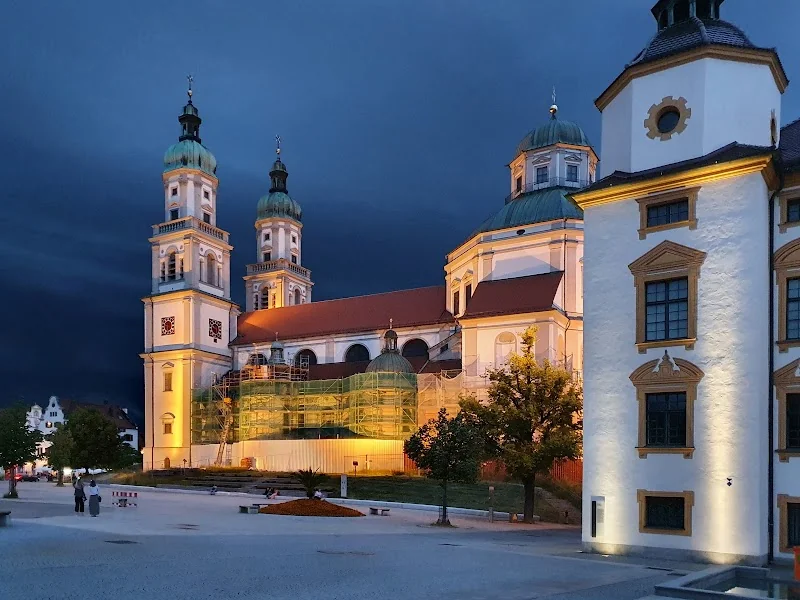
The Hildegardplatz is one of the most distinctive and vibrant places in Kempten (Allgäu). When you arrive here, you are not just standing in a square, but in the midst of a historical sequence of spaces that connects the Basilica of St. Lorenz, the Residence, and the Old Town. Located south of the basilica, the square has existed in the same place since the 17th century and is today an integral part of the baroque cityscape. At the same time, it is one of the most well-known meeting points in the city, as the weekly market takes place here on Wednesdays and Saturdays, where shopping, encounters, urban life, and history overlap in a small space. Thus, the square serves as a point of orientation, a place to stay, and an urban stage. For visitors, it is an ideal starting point to experience Kempten, and for locals, it is a place where people naturally meet, linger, and feel the vibrant center of the city directly. ([kempten-tourismus.de](https://www.kempten-tourismus.de/plaetze))
Weekly Market at Hildegardplatz: Times, Stalls, and Atmosphere
The strongest theme surrounding the Hildegardplatz is clearly the weekly market. According to Kempten Tourism, it takes place twice a week directly on the square, specifically on Wednesdays and Saturdays from 07:00 to 13:00. About 50 stalls bring seasonal fruits and vegetables, cheese, fish, and sausage specialties, homemade pasta, plants, honey, and many other products from Kempten, the Allgäu, Lake Constance, or even Italy into the city center. This gives the square not only the character of a market but also that of a small culinary world in the midst of the Old Town. This mix of regionality and diversity makes the market so attractive: those looking for fresh food will find it just as easily as gourmet foods, snack options, and everyday necessities. For many people, the market is therefore much more than just a shopping appointment. It is a ritual, a meeting point, and a piece of lived urban culture. The Hildegardplatz visibly shows how strongly a market can shape the face of a city center when it takes place regularly and is embraced by both residents and guests alike. ([kempten-tourismus.de](https://www.kempten-tourismus.de/wochenmarkt))
The atmosphere at the weekly market is intentionally lively and open. The market fountain in the center of the square is a meeting point, a focal point, and a place where both young and old gather. According to the official description, people meet here for breakfast, lunch, or simply for a conversation; on sunny days, the market area around the fountain is even visited by up to 1,000 visitors. This makes the Hildegardplatz a place with high social density, without losing its historical impact. At the same time, there are clear rules: dogs are not allowed at the weekly market, except for guide dogs, and cycling through the market is also prohibited. If a market day falls on a public holiday, the city moves the market to the previous working day. This mix of organization and openness ensures that the Hildegardplatz not only looks beautiful but also functions well in everyday life. For inquiries such as hildegardplatz kempten today, it is particularly important to know that the greatest liveliness occurs here on market days when the square is used in its full width. ([kempten-tourismus.de](https://www.kempten-tourismus.de/wochenmarkt))
Parking and Access to Hildegardplatz in Kempten
When looking at the keyword cluster around parking and routes, it quickly becomes clear that the Hildegardplatz is located in the middle of a well-developed city center. Kempten Tourism describes the city's parking system as well-developed and equipped with numerous centrally located parking areas. Orientation is supported by a parking guidance system that leads to free parking spaces or the nearest parking garage. Additionally, the city points out that parking in Kempten is usually subject to fees and can be paid with coins, credit cards, or via an app, depending on the area. Therefore, those arriving by car will generally find a well-structured parking landscape in the city center but should expect paid parking. This is particularly important for visitors who only want to briefly visit the weekly market or the Old Town, as the city center is intentionally designed for short distances and central accessibility. E-charging stations are also available in several parking areas, making the location prepared for different mobility needs. For searches related to maps or routes, it is particularly relevant that the square is very centrally located and directly adjoins a highly frequented Old Town zone. ([kempten-tourismus.de](https://www.kempten-tourismus.de/parken))
For the Hildegardplatz itself, a session document from the city of Kempten from 2025 provides very specific numbers: There are currently a total of 51 paid short-term parking spaces available with a maximum parking duration of one hour, from Monday to Saturday from 09:00 to 19:00. Additionally, there are three disabled parking spaces, and the area is located in a resident parking zone. These details are particularly important for people specifically looking for hildegardplatz kempten parking or hildegardplatz 5 kempten, as they understand the square not only as a tourist point but as a practical urban space. The short-term regulation shows that the area is designed for quick accessibility and short stays. This is sensible for the everyday life of the city center, as the square is located in a very densely used environment. Therefore, anyone going to the market, a café, a shop, or an appointment in the vicinity should keep the limited parking duration in mind. This is the typical character of the square: it is central, attractive, and easily accessible, but also urbanly organized and not to be understood as an arbitrary free parking space. ([ratsinfo.kempten.de](https://ratsinfo.kempten.de/bi/getfile.php?id=83067&type=do))
History and Baroque Layout of Hildegardplatz
Historically, the Hildegardplatz is much more than just an open space. The official city description places it within the baroque square layout surrounding the Basilica of St. Lorenz. Located south of this church, the square has existed in its current location since the 17th century. This is crucial for the perception of the square, as it becomes clear that its significance arises from historical urban development and was not created solely through modern use. The basilica itself is described by Kempten Tourism as the first baroque church building in southern Germany after the Thirty Years' War. This classification makes it understandable why the square is so strongly connected to the historical center: it is not only a forecourt but part of a deliberately staged urban space where church, residence, square, and pathways interact. This creates a very cohesive image for guests visiting Kempten for the first time. The Hildegardplatz serves as an interface between sacred architecture, civic everyday life, and tourist use. This historical depth is one of the main reasons why the square is so frequently sought after when people look for history, cityscape, and special features in Kempten. ([kempten-tourismus.de](https://www.kempten-tourismus.de/plaetze))
The larger urban context also explains much of the square's current impact. The Basilica of St. Lorenz is, according to Kempten Tourism, not to be viewed as a single building but as a complete picture with the surrounding square layout. The historical narrative includes the former double city, the development of Kempten in the context of the abbey and imperial city, as well as the close spatial relationship between the most important squares of the Old Town. The Hildegardplatz is thus part of an ensemble that tells the history of Kempten not abstractly but makes it spatially experienceable. Walking across the square, one moves through centuries of urban development. This also explains why the square continues to appear so prominently in the official city and tourism presentations. It does not stand isolated but is part of a historical network of basilica, residence, abbey square, corn house square, and other places that shape the center of Kempten. For content related to hildegardplatz kempten (allgäu), this embedding is crucial: the square is not a peripheral point but one of the central building blocks of the urban identity space. ([kempten-tourismus.de](https://www.kempten-tourismus.de/basilika-st-lorenz))
Market Fountain, Stay, and Urban Quality of Life
Another central element of the Hildegardplatz is the market fountain. Kempten Tourism describes it as a meeting point at the weekly market and also classifies it as a newer monument, erected in 2013. Its symbolism is particularly interesting: the fountain stands in the center of the square and refers to the unification of the former imperial city and the abbey city into today's united Kempten. This translates a historical process into a visible urban object. This is very effective for a square because it is thus charged not only functionally but also narratively. Additionally, the city's tourism page points out a drinking fountain at Hildegardplatz, whose water flows from the mouths of animals. Such details may seem small but greatly contribute to the perception of the square as they enhance the character of the stay. The Hildegardplatz is therefore not just a passageway or market area but a place with recognition value where design, symbolism, and everyday life connect. This is exactly what makes the square so interesting for visitors: it tells a story about an object while simultaneously inviting people to linger. ([kempten-tourismus.de](https://www.kempten-tourismus.de/wochenmarkt))
The quality of stay at the square is clearly highlighted in the official descriptions. Around the Hildegardplatz, there are benches, shaded areas, and an open space where families, skaters, walkers, and market visitors meet. The tourism presentation also mentions cafés and small shops in the vicinity that invite for strolling and lingering. Particularly in combination with the market, this creates an urban image that allows for many different types of use: morning shopping, lunchtime breaks, afternoon meeting points, and lively city stages on event days. This flexible character is a strength of the square and explains why it is often described as a favorite place in Kempten. For people searching for hildegardplatz kempten today, this is the best classification: the square is usable almost daily, but its maximum liveliness is reached on market days and in good weather. Its combination of historical backdrop, fountain, seating options, and central location makes it one of the places where Kempten can be experienced most easily and pleasantly. ([kempten-tourismus.de](https://www.kempten-tourismus.de/basilika-st-lorenz))
Around Hildegardplatz: Basilica, Residence, Zumsteinhaus, and Northern City Center
Anyone visiting the Hildegardplatz automatically stands in the midst of a dense network of sights. Directly adjacent is the Basilica of St. Lorenz, whose baroque effect shapes the entire square layout. In close proximity are also the Residence, the Court Garden, and the Kempten Museum in the Zumsteinhaus. The Zumsteinhaus itself is a representative bourgeois palace built in 1802 by the merchant family Zumstein de la Pierre from Savoy in a central location at Hildegardplatz. Later, it served as a museum and was eventually developed into the current Kempten Museum. This creates an exceptionally dense historical connection around the square, consisting of sacred buildings, power architecture, bourgeois palaces, and urban market spaces. For visitors, this is ideal because several facets of the city's history can be connected here without long distances. Therefore, anyone visiting the Hildegardplatz should not only consider the square itself but also incorporate the adjacent buildings and axes into their planning. This is exactly how a market visit becomes a complete Old Town tour. ([kempten-museum.de](https://kempten-museum.de/de/ueber-uns/zumsteinhaus))
The location is also excellently embedded from an urban planning perspective. The City Management Kempten describes the area around the Residence as the heart of the redevelopment area Northern City Center, with the Hildegardplatz located to the west. As part of this neighborhood development, activities are being created and are being created that further enliven the city center, including formats such as city festivals, shopping nights, mobility days, music days, or sports and family days. This shows: the Hildegardplatz is not only a historical backdrop but part of an actively maintained city center development. For search intentions related to maps, routes, and parking, this is important because the square is located in a strong, well-organized urban environment. At the same time, it becomes clear why the square is also interesting for events and gastronomic uses. It is a hub where tourism, commerce, everyday life, and urban culture meet. Therefore, anyone visiting the Hildegardplatz in Kempten experiences not just a single place but an entire urban scene where baroque architecture, market activities, and modern city center functions come together. ([cm-kempten.de](https://www.cm-kempten.de/quartiersmanagement/))
The historical and urban significance of the square is finally underscored by the fact that it repeatedly appears in official overviews of squares, fountains, and urban development. Together with the Abbey Square, Residence Square, and Corn House Square, it forms one of the most important spaces of the Kempten Old Town. This connection makes the Hildegardplatz so attractive for guests because a complete route through the historical city center can be developed here without having to cover long distances. For a visit, this means: market, basilica, residence, museum, cafés, and walks can be combined in one day. Therefore, for those interested not just in a single appointment but in the overall picture of the city, the Hildegardplatz offers perhaps the best entry point. It is a market place, meeting place, orientation point, and part of a multifaceted ensemble that showcases Kempten as a city with a historical profile and vibrant present. ([kempten-tourismus.de](https://www.kempten-tourismus.de/plaetze?utm_source=openai))
Sources:
Show moreShow less
Hildegardplatz | Weekly Market & Parking
The Hildegardplatz is one of the most distinctive and vibrant places in Kempten (Allgäu). When you arrive here, you are not just standing in a square, but in the midst of a historical sequence of spaces that connects the Basilica of St. Lorenz, the Residence, and the Old Town. Located south of the basilica, the square has existed in the same place since the 17th century and is today an integral part of the baroque cityscape. At the same time, it is one of the most well-known meeting points in the city, as the weekly market takes place here on Wednesdays and Saturdays, where shopping, encounters, urban life, and history overlap in a small space. Thus, the square serves as a point of orientation, a place to stay, and an urban stage. For visitors, it is an ideal starting point to experience Kempten, and for locals, it is a place where people naturally meet, linger, and feel the vibrant center of the city directly. ([kempten-tourismus.de](https://www.kempten-tourismus.de/plaetze))
Weekly Market at Hildegardplatz: Times, Stalls, and Atmosphere
The strongest theme surrounding the Hildegardplatz is clearly the weekly market. According to Kempten Tourism, it takes place twice a week directly on the square, specifically on Wednesdays and Saturdays from 07:00 to 13:00. About 50 stalls bring seasonal fruits and vegetables, cheese, fish, and sausage specialties, homemade pasta, plants, honey, and many other products from Kempten, the Allgäu, Lake Constance, or even Italy into the city center. This gives the square not only the character of a market but also that of a small culinary world in the midst of the Old Town. This mix of regionality and diversity makes the market so attractive: those looking for fresh food will find it just as easily as gourmet foods, snack options, and everyday necessities. For many people, the market is therefore much more than just a shopping appointment. It is a ritual, a meeting point, and a piece of lived urban culture. The Hildegardplatz visibly shows how strongly a market can shape the face of a city center when it takes place regularly and is embraced by both residents and guests alike. ([kempten-tourismus.de](https://www.kempten-tourismus.de/wochenmarkt))
The atmosphere at the weekly market is intentionally lively and open. The market fountain in the center of the square is a meeting point, a focal point, and a place where both young and old gather. According to the official description, people meet here for breakfast, lunch, or simply for a conversation; on sunny days, the market area around the fountain is even visited by up to 1,000 visitors. This makes the Hildegardplatz a place with high social density, without losing its historical impact. At the same time, there are clear rules: dogs are not allowed at the weekly market, except for guide dogs, and cycling through the market is also prohibited. If a market day falls on a public holiday, the city moves the market to the previous working day. This mix of organization and openness ensures that the Hildegardplatz not only looks beautiful but also functions well in everyday life. For inquiries such as hildegardplatz kempten today, it is particularly important to know that the greatest liveliness occurs here on market days when the square is used in its full width. ([kempten-tourismus.de](https://www.kempten-tourismus.de/wochenmarkt))
Parking and Access to Hildegardplatz in Kempten
When looking at the keyword cluster around parking and routes, it quickly becomes clear that the Hildegardplatz is located in the middle of a well-developed city center. Kempten Tourism describes the city's parking system as well-developed and equipped with numerous centrally located parking areas. Orientation is supported by a parking guidance system that leads to free parking spaces or the nearest parking garage. Additionally, the city points out that parking in Kempten is usually subject to fees and can be paid with coins, credit cards, or via an app, depending on the area. Therefore, those arriving by car will generally find a well-structured parking landscape in the city center but should expect paid parking. This is particularly important for visitors who only want to briefly visit the weekly market or the Old Town, as the city center is intentionally designed for short distances and central accessibility. E-charging stations are also available in several parking areas, making the location prepared for different mobility needs. For searches related to maps or routes, it is particularly relevant that the square is very centrally located and directly adjoins a highly frequented Old Town zone. ([kempten-tourismus.de](https://www.kempten-tourismus.de/parken))
For the Hildegardplatz itself, a session document from the city of Kempten from 2025 provides very specific numbers: There are currently a total of 51 paid short-term parking spaces available with a maximum parking duration of one hour, from Monday to Saturday from 09:00 to 19:00. Additionally, there are three disabled parking spaces, and the area is located in a resident parking zone. These details are particularly important for people specifically looking for hildegardplatz kempten parking or hildegardplatz 5 kempten, as they understand the square not only as a tourist point but as a practical urban space. The short-term regulation shows that the area is designed for quick accessibility and short stays. This is sensible for the everyday life of the city center, as the square is located in a very densely used environment. Therefore, anyone going to the market, a café, a shop, or an appointment in the vicinity should keep the limited parking duration in mind. This is the typical character of the square: it is central, attractive, and easily accessible, but also urbanly organized and not to be understood as an arbitrary free parking space. ([ratsinfo.kempten.de](https://ratsinfo.kempten.de/bi/getfile.php?id=83067&type=do))
History and Baroque Layout of Hildegardplatz
Historically, the Hildegardplatz is much more than just an open space. The official city description places it within the baroque square layout surrounding the Basilica of St. Lorenz. Located south of this church, the square has existed in its current location since the 17th century. This is crucial for the perception of the square, as it becomes clear that its significance arises from historical urban development and was not created solely through modern use. The basilica itself is described by Kempten Tourism as the first baroque church building in southern Germany after the Thirty Years' War. This classification makes it understandable why the square is so strongly connected to the historical center: it is not only a forecourt but part of a deliberately staged urban space where church, residence, square, and pathways interact. This creates a very cohesive image for guests visiting Kempten for the first time. The Hildegardplatz serves as an interface between sacred architecture, civic everyday life, and tourist use. This historical depth is one of the main reasons why the square is so frequently sought after when people look for history, cityscape, and special features in Kempten. ([kempten-tourismus.de](https://www.kempten-tourismus.de/plaetze))
The larger urban context also explains much of the square's current impact. The Basilica of St. Lorenz is, according to Kempten Tourism, not to be viewed as a single building but as a complete picture with the surrounding square layout. The historical narrative includes the former double city, the development of Kempten in the context of the abbey and imperial city, as well as the close spatial relationship between the most important squares of the Old Town. The Hildegardplatz is thus part of an ensemble that tells the history of Kempten not abstractly but makes it spatially experienceable. Walking across the square, one moves through centuries of urban development. This also explains why the square continues to appear so prominently in the official city and tourism presentations. It does not stand isolated but is part of a historical network of basilica, residence, abbey square, corn house square, and other places that shape the center of Kempten. For content related to hildegardplatz kempten (allgäu), this embedding is crucial: the square is not a peripheral point but one of the central building blocks of the urban identity space. ([kempten-tourismus.de](https://www.kempten-tourismus.de/basilika-st-lorenz))
Market Fountain, Stay, and Urban Quality of Life
Another central element of the Hildegardplatz is the market fountain. Kempten Tourism describes it as a meeting point at the weekly market and also classifies it as a newer monument, erected in 2013. Its symbolism is particularly interesting: the fountain stands in the center of the square and refers to the unification of the former imperial city and the abbey city into today's united Kempten. This translates a historical process into a visible urban object. This is very effective for a square because it is thus charged not only functionally but also narratively. Additionally, the city's tourism page points out a drinking fountain at Hildegardplatz, whose water flows from the mouths of animals. Such details may seem small but greatly contribute to the perception of the square as they enhance the character of the stay. The Hildegardplatz is therefore not just a passageway or market area but a place with recognition value where design, symbolism, and everyday life connect. This is exactly what makes the square so interesting for visitors: it tells a story about an object while simultaneously inviting people to linger. ([kempten-tourismus.de](https://www.kempten-tourismus.de/wochenmarkt))
The quality of stay at the square is clearly highlighted in the official descriptions. Around the Hildegardplatz, there are benches, shaded areas, and an open space where families, skaters, walkers, and market visitors meet. The tourism presentation also mentions cafés and small shops in the vicinity that invite for strolling and lingering. Particularly in combination with the market, this creates an urban image that allows for many different types of use: morning shopping, lunchtime breaks, afternoon meeting points, and lively city stages on event days. This flexible character is a strength of the square and explains why it is often described as a favorite place in Kempten. For people searching for hildegardplatz kempten today, this is the best classification: the square is usable almost daily, but its maximum liveliness is reached on market days and in good weather. Its combination of historical backdrop, fountain, seating options, and central location makes it one of the places where Kempten can be experienced most easily and pleasantly. ([kempten-tourismus.de](https://www.kempten-tourismus.de/basilika-st-lorenz))
Around Hildegardplatz: Basilica, Residence, Zumsteinhaus, and Northern City Center
Anyone visiting the Hildegardplatz automatically stands in the midst of a dense network of sights. Directly adjacent is the Basilica of St. Lorenz, whose baroque effect shapes the entire square layout. In close proximity are also the Residence, the Court Garden, and the Kempten Museum in the Zumsteinhaus. The Zumsteinhaus itself is a representative bourgeois palace built in 1802 by the merchant family Zumstein de la Pierre from Savoy in a central location at Hildegardplatz. Later, it served as a museum and was eventually developed into the current Kempten Museum. This creates an exceptionally dense historical connection around the square, consisting of sacred buildings, power architecture, bourgeois palaces, and urban market spaces. For visitors, this is ideal because several facets of the city's history can be connected here without long distances. Therefore, anyone visiting the Hildegardplatz should not only consider the square itself but also incorporate the adjacent buildings and axes into their planning. This is exactly how a market visit becomes a complete Old Town tour. ([kempten-museum.de](https://kempten-museum.de/de/ueber-uns/zumsteinhaus))
The location is also excellently embedded from an urban planning perspective. The City Management Kempten describes the area around the Residence as the heart of the redevelopment area Northern City Center, with the Hildegardplatz located to the west. As part of this neighborhood development, activities are being created and are being created that further enliven the city center, including formats such as city festivals, shopping nights, mobility days, music days, or sports and family days. This shows: the Hildegardplatz is not only a historical backdrop but part of an actively maintained city center development. For search intentions related to maps, routes, and parking, this is important because the square is located in a strong, well-organized urban environment. At the same time, it becomes clear why the square is also interesting for events and gastronomic uses. It is a hub where tourism, commerce, everyday life, and urban culture meet. Therefore, anyone visiting the Hildegardplatz in Kempten experiences not just a single place but an entire urban scene where baroque architecture, market activities, and modern city center functions come together. ([cm-kempten.de](https://www.cm-kempten.de/quartiersmanagement/))
The historical and urban significance of the square is finally underscored by the fact that it repeatedly appears in official overviews of squares, fountains, and urban development. Together with the Abbey Square, Residence Square, and Corn House Square, it forms one of the most important spaces of the Kempten Old Town. This connection makes the Hildegardplatz so attractive for guests because a complete route through the historical city center can be developed here without having to cover long distances. For a visit, this means: market, basilica, residence, museum, cafés, and walks can be combined in one day. Therefore, for those interested not just in a single appointment but in the overall picture of the city, the Hildegardplatz offers perhaps the best entry point. It is a market place, meeting place, orientation point, and part of a multifaceted ensemble that showcases Kempten as a city with a historical profile and vibrant present. ([kempten-tourismus.de](https://www.kempten-tourismus.de/plaetze?utm_source=openai))
Sources:
Hildegardplatz | Weekly Market & Parking
The Hildegardplatz is one of the most distinctive and vibrant places in Kempten (Allgäu). When you arrive here, you are not just standing in a square, but in the midst of a historical sequence of spaces that connects the Basilica of St. Lorenz, the Residence, and the Old Town. Located south of the basilica, the square has existed in the same place since the 17th century and is today an integral part of the baroque cityscape. At the same time, it is one of the most well-known meeting points in the city, as the weekly market takes place here on Wednesdays and Saturdays, where shopping, encounters, urban life, and history overlap in a small space. Thus, the square serves as a point of orientation, a place to stay, and an urban stage. For visitors, it is an ideal starting point to experience Kempten, and for locals, it is a place where people naturally meet, linger, and feel the vibrant center of the city directly. ([kempten-tourismus.de](https://www.kempten-tourismus.de/plaetze))
Weekly Market at Hildegardplatz: Times, Stalls, and Atmosphere
The strongest theme surrounding the Hildegardplatz is clearly the weekly market. According to Kempten Tourism, it takes place twice a week directly on the square, specifically on Wednesdays and Saturdays from 07:00 to 13:00. About 50 stalls bring seasonal fruits and vegetables, cheese, fish, and sausage specialties, homemade pasta, plants, honey, and many other products from Kempten, the Allgäu, Lake Constance, or even Italy into the city center. This gives the square not only the character of a market but also that of a small culinary world in the midst of the Old Town. This mix of regionality and diversity makes the market so attractive: those looking for fresh food will find it just as easily as gourmet foods, snack options, and everyday necessities. For many people, the market is therefore much more than just a shopping appointment. It is a ritual, a meeting point, and a piece of lived urban culture. The Hildegardplatz visibly shows how strongly a market can shape the face of a city center when it takes place regularly and is embraced by both residents and guests alike. ([kempten-tourismus.de](https://www.kempten-tourismus.de/wochenmarkt))
The atmosphere at the weekly market is intentionally lively and open. The market fountain in the center of the square is a meeting point, a focal point, and a place where both young and old gather. According to the official description, people meet here for breakfast, lunch, or simply for a conversation; on sunny days, the market area around the fountain is even visited by up to 1,000 visitors. This makes the Hildegardplatz a place with high social density, without losing its historical impact. At the same time, there are clear rules: dogs are not allowed at the weekly market, except for guide dogs, and cycling through the market is also prohibited. If a market day falls on a public holiday, the city moves the market to the previous working day. This mix of organization and openness ensures that the Hildegardplatz not only looks beautiful but also functions well in everyday life. For inquiries such as hildegardplatz kempten today, it is particularly important to know that the greatest liveliness occurs here on market days when the square is used in its full width. ([kempten-tourismus.de](https://www.kempten-tourismus.de/wochenmarkt))
Parking and Access to Hildegardplatz in Kempten
When looking at the keyword cluster around parking and routes, it quickly becomes clear that the Hildegardplatz is located in the middle of a well-developed city center. Kempten Tourism describes the city's parking system as well-developed and equipped with numerous centrally located parking areas. Orientation is supported by a parking guidance system that leads to free parking spaces or the nearest parking garage. Additionally, the city points out that parking in Kempten is usually subject to fees and can be paid with coins, credit cards, or via an app, depending on the area. Therefore, those arriving by car will generally find a well-structured parking landscape in the city center but should expect paid parking. This is particularly important for visitors who only want to briefly visit the weekly market or the Old Town, as the city center is intentionally designed for short distances and central accessibility. E-charging stations are also available in several parking areas, making the location prepared for different mobility needs. For searches related to maps or routes, it is particularly relevant that the square is very centrally located and directly adjoins a highly frequented Old Town zone. ([kempten-tourismus.de](https://www.kempten-tourismus.de/parken))
For the Hildegardplatz itself, a session document from the city of Kempten from 2025 provides very specific numbers: There are currently a total of 51 paid short-term parking spaces available with a maximum parking duration of one hour, from Monday to Saturday from 09:00 to 19:00. Additionally, there are three disabled parking spaces, and the area is located in a resident parking zone. These details are particularly important for people specifically looking for hildegardplatz kempten parking or hildegardplatz 5 kempten, as they understand the square not only as a tourist point but as a practical urban space. The short-term regulation shows that the area is designed for quick accessibility and short stays. This is sensible for the everyday life of the city center, as the square is located in a very densely used environment. Therefore, anyone going to the market, a café, a shop, or an appointment in the vicinity should keep the limited parking duration in mind. This is the typical character of the square: it is central, attractive, and easily accessible, but also urbanly organized and not to be understood as an arbitrary free parking space. ([ratsinfo.kempten.de](https://ratsinfo.kempten.de/bi/getfile.php?id=83067&type=do))
History and Baroque Layout of Hildegardplatz
Historically, the Hildegardplatz is much more than just an open space. The official city description places it within the baroque square layout surrounding the Basilica of St. Lorenz. Located south of this church, the square has existed in its current location since the 17th century. This is crucial for the perception of the square, as it becomes clear that its significance arises from historical urban development and was not created solely through modern use. The basilica itself is described by Kempten Tourism as the first baroque church building in southern Germany after the Thirty Years' War. This classification makes it understandable why the square is so strongly connected to the historical center: it is not only a forecourt but part of a deliberately staged urban space where church, residence, square, and pathways interact. This creates a very cohesive image for guests visiting Kempten for the first time. The Hildegardplatz serves as an interface between sacred architecture, civic everyday life, and tourist use. This historical depth is one of the main reasons why the square is so frequently sought after when people look for history, cityscape, and special features in Kempten. ([kempten-tourismus.de](https://www.kempten-tourismus.de/plaetze))
The larger urban context also explains much of the square's current impact. The Basilica of St. Lorenz is, according to Kempten Tourism, not to be viewed as a single building but as a complete picture with the surrounding square layout. The historical narrative includes the former double city, the development of Kempten in the context of the abbey and imperial city, as well as the close spatial relationship between the most important squares of the Old Town. The Hildegardplatz is thus part of an ensemble that tells the history of Kempten not abstractly but makes it spatially experienceable. Walking across the square, one moves through centuries of urban development. This also explains why the square continues to appear so prominently in the official city and tourism presentations. It does not stand isolated but is part of a historical network of basilica, residence, abbey square, corn house square, and other places that shape the center of Kempten. For content related to hildegardplatz kempten (allgäu), this embedding is crucial: the square is not a peripheral point but one of the central building blocks of the urban identity space. ([kempten-tourismus.de](https://www.kempten-tourismus.de/basilika-st-lorenz))
Market Fountain, Stay, and Urban Quality of Life
Another central element of the Hildegardplatz is the market fountain. Kempten Tourism describes it as a meeting point at the weekly market and also classifies it as a newer monument, erected in 2013. Its symbolism is particularly interesting: the fountain stands in the center of the square and refers to the unification of the former imperial city and the abbey city into today's united Kempten. This translates a historical process into a visible urban object. This is very effective for a square because it is thus charged not only functionally but also narratively. Additionally, the city's tourism page points out a drinking fountain at Hildegardplatz, whose water flows from the mouths of animals. Such details may seem small but greatly contribute to the perception of the square as they enhance the character of the stay. The Hildegardplatz is therefore not just a passageway or market area but a place with recognition value where design, symbolism, and everyday life connect. This is exactly what makes the square so interesting for visitors: it tells a story about an object while simultaneously inviting people to linger. ([kempten-tourismus.de](https://www.kempten-tourismus.de/wochenmarkt))
The quality of stay at the square is clearly highlighted in the official descriptions. Around the Hildegardplatz, there are benches, shaded areas, and an open space where families, skaters, walkers, and market visitors meet. The tourism presentation also mentions cafés and small shops in the vicinity that invite for strolling and lingering. Particularly in combination with the market, this creates an urban image that allows for many different types of use: morning shopping, lunchtime breaks, afternoon meeting points, and lively city stages on event days. This flexible character is a strength of the square and explains why it is often described as a favorite place in Kempten. For people searching for hildegardplatz kempten today, this is the best classification: the square is usable almost daily, but its maximum liveliness is reached on market days and in good weather. Its combination of historical backdrop, fountain, seating options, and central location makes it one of the places where Kempten can be experienced most easily and pleasantly. ([kempten-tourismus.de](https://www.kempten-tourismus.de/basilika-st-lorenz))
Around Hildegardplatz: Basilica, Residence, Zumsteinhaus, and Northern City Center
Anyone visiting the Hildegardplatz automatically stands in the midst of a dense network of sights. Directly adjacent is the Basilica of St. Lorenz, whose baroque effect shapes the entire square layout. In close proximity are also the Residence, the Court Garden, and the Kempten Museum in the Zumsteinhaus. The Zumsteinhaus itself is a representative bourgeois palace built in 1802 by the merchant family Zumstein de la Pierre from Savoy in a central location at Hildegardplatz. Later, it served as a museum and was eventually developed into the current Kempten Museum. This creates an exceptionally dense historical connection around the square, consisting of sacred buildings, power architecture, bourgeois palaces, and urban market spaces. For visitors, this is ideal because several facets of the city's history can be connected here without long distances. Therefore, anyone visiting the Hildegardplatz should not only consider the square itself but also incorporate the adjacent buildings and axes into their planning. This is exactly how a market visit becomes a complete Old Town tour. ([kempten-museum.de](https://kempten-museum.de/de/ueber-uns/zumsteinhaus))
The location is also excellently embedded from an urban planning perspective. The City Management Kempten describes the area around the Residence as the heart of the redevelopment area Northern City Center, with the Hildegardplatz located to the west. As part of this neighborhood development, activities are being created and are being created that further enliven the city center, including formats such as city festivals, shopping nights, mobility days, music days, or sports and family days. This shows: the Hildegardplatz is not only a historical backdrop but part of an actively maintained city center development. For search intentions related to maps, routes, and parking, this is important because the square is located in a strong, well-organized urban environment. At the same time, it becomes clear why the square is also interesting for events and gastronomic uses. It is a hub where tourism, commerce, everyday life, and urban culture meet. Therefore, anyone visiting the Hildegardplatz in Kempten experiences not just a single place but an entire urban scene where baroque architecture, market activities, and modern city center functions come together. ([cm-kempten.de](https://www.cm-kempten.de/quartiersmanagement/))
The historical and urban significance of the square is finally underscored by the fact that it repeatedly appears in official overviews of squares, fountains, and urban development. Together with the Abbey Square, Residence Square, and Corn House Square, it forms one of the most important spaces of the Kempten Old Town. This connection makes the Hildegardplatz so attractive for guests because a complete route through the historical city center can be developed here without having to cover long distances. For a visit, this means: market, basilica, residence, museum, cafés, and walks can be combined in one day. Therefore, for those interested not just in a single appointment but in the overall picture of the city, the Hildegardplatz offers perhaps the best entry point. It is a market place, meeting place, orientation point, and part of a multifaceted ensemble that showcases Kempten as a city with a historical profile and vibrant present. ([kempten-tourismus.de](https://www.kempten-tourismus.de/plaetze?utm_source=openai))
Sources:
Upcoming Events
No events found
Frequently Asked Questions
Reviews
No reviews found