
Kempten (Allgäu)
Unnamed Road 87437, 87437 Kempten (Allgäu), Deutschland
BikeBox Charging Station | Parking & E-Bike Charging
The BikeBox charging station in Kempten is not a traditional event venue, but a modern mobility hub for people who want to experience the city on two wheels. Located centrally in Grabengasse, it combines secure bike parking, charging function for e-bike batteries, and practical storage with a compact, everyday-friendly service. For day visitors, commuters, cyclists, and anyone who wants to get around Kempten quickly and easily, this location is a valuable anchor point. The city includes the BikeBox in its mobility and tourism information, demonstrating that bike parking, charging infrastructure, and short distances are now an integral part of the urban experience. Additionally, the BikeBox serves as a meeting point for city tours and thus also as a reference point for visitors exploring the city center, the Iller river, and the old town either independently or as part of a guided tour. This combination of function, location, and urban integration makes the site interesting: not loud, not staged, but useful, approachable, and surprisingly versatile. ([kempten-tourismus.de](https://www.kempten-tourismus.de/parken?utm_source=openai))
Parking and Charging in Grabengasse
Those arriving in Kempten by bike or e-bike will find a central opportunity to securely park their bike and start their stay in the city center relaxed at the BikeBox in Grabengasse. The official tourism website describes the location as centrally located and emphasizes that not only can you park your bike there, but also lockers are available for charging e-bike batteries and securely storing personal items. This combination is particularly sensible for urban life: the bike is protected, the battery can gain energy during the stay, and valuables remain organized in one place. At the same time, the location in Grabengasse makes the site attractive for short distances to the city center, for errands, for a café visit, or for a walk through the center. Kempten Tourism clearly categorizes the BikeBox under the topic of parking and charging for bicycles. The English information page also refers to the BikeBox in Grabengasse and highlights the secure storage as well as the opportunity to charge the battery and safely stow personal belongings. This is more than just a parking space: it is a small, well-thought-out service infrastructure that facilitates the transition between mobility and stay for cyclists. Especially in a city where distances are often short and many errands can be done on foot, such a point is valuable because it strengthens the bicycle as a flexible option and makes arriving in the city center easier. ([kempten-tourismus.de](https://www.kempten-tourismus.de/parken?utm_source=openai))
Facilities of the BikeBox: Lockers, Battery Charging, and Repair Station
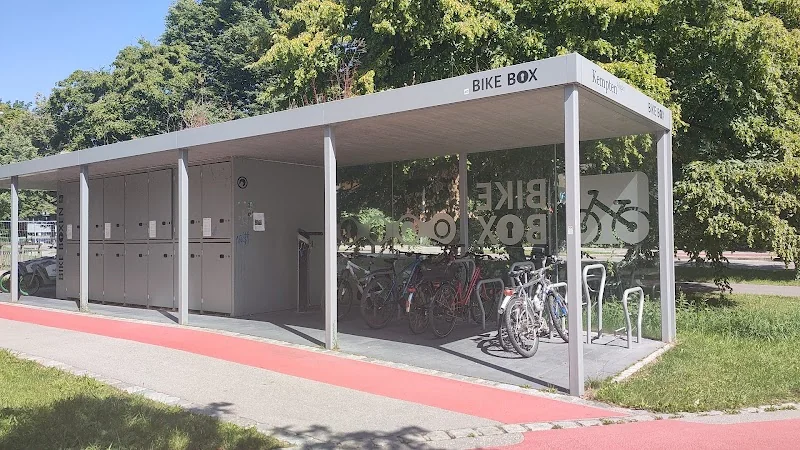
The BikeBox is not just a place to park, but a carefully designed component of bike infrastructure. The project report on the implementation in Kempten describes the location in Grabengasse as the largest station to date. The BikeBox consists of a roof measuring approximately 15 by 3 meters, bike racks on both sides, and a block of lockers of varying sizes in the middle. These lockers serve multiple purposes: they are used for storing luggage, can be utilized for charging a battery, and depending on the need, even provide space to securely store an entire bike. Additionally, a small repair station is integrated. Architecturally, a balance between openness and protection has been consciously created. The planning focuses on transparency, social control, and good visibility, while also providing effective protection against rain, snow, theft, and damage. The modular concept is also important: the BikeBox can be adapted to locations and requirements and expanded if necessary. This makes the facility future-proof and explains why it works so well in urban areas. For cyclists, this means: those who stop here find not only a parking space but a small service zone with a clear function. Especially in a city center where time is short and distances are small, this combination of protection, comfort, and simplicity is a real advantage. The BikeBox shows how modern bike stations can be conceived today: functional, modular, robust, and at the same time architecturally understated. ([vb.nweurope.eu](https://vb.nweurope.eu/media/19648/dt151-implementation-report-kempten.pdf))
Mobility Point Grabengasse and Sustainable Mobility in Kempten
The BikeBox in Kempten is not isolated but part of a larger mobility concept. According to the project report, Kempten has been a partner in the European eHUBS project since 2019, which aims to expand shared electric mobility in cities and reduce greenhouse gas emissions. As part of this initiative, several mobility points have been developed in Kempten, and Grabengasse is particularly significant: it is described as the largest station and was already established as a BikeBox before the eHUBS project. The location was opened in September 2020 with two cars; cargo bikes were added in October 2021. According to the report, the two vehicles at this location have been intensively used, and the development shows that sustainable mobility offerings in Kempten are not only planned but also actually embraced. The tourism and mobility pages of the city also address this idea and refer to Kempten's first mobility point in Grabengasse, near which an e-vehicle can be rented. Thus, the BikeBox is part of a network that connects bike parking, charging functions, sharing offers, and short distances. For visitors, this means a significant simplification: those arriving by bike find a place to park; those traveling electrically find complementary offers; and those planning to combine their stay in Kempten with city walks, tours, or errands benefit from a well-visible, central infrastructure. This way, the BikeBox becomes a building block for more sustainable urban mobility. ([vb.nweurope.eu](https://vb.nweurope.eu/media/19648/dt151-implementation-report-kempten.pdf))
Location, Access, and Accessibility in the Center
A key advantage of the BikeBox is its location. The architectural concept for the Grabengasse location describes the area as a space in front of the historical edge of the town in a wide green zone that separates the old town from the Iller river. At the same time, the station is directly on the existing bike path network and close to the city center. A significant pathway leads from the city center to the east and back over the Iller bridge, placing the BikeBox on a true movement line and not at an edge without reference to the city core. This is crucial for everyday use: the location is chosen so that it can be quickly found, that it lies on the way, and that it fits into existing movement flows. Kempten Tourism additionally describes the BikeBox as a centrally located solution, and the city also uses the site as a meeting point for city tours. For visitors, this is practical because they do not have to search long, but have an immediately well-integrated starting point. The combination of city center location, bike path network, proximity to the tourist information center, and connection to the Iller makes the site particularly legible. Those who continue to explore the city on foot can securely park their bike here and proceed without detours. Those arriving by bike can use the location as a reference point. And those getting to know Kempten from a tourist perspective experience a place where mobility and urban experience converge. The BikeBox thus vividly demonstrates how a good location makes the use of infrastructure pleasant. ([f64architekten.de](https://www.f64architekten.de/projekte/sortiert/chronologisch/detail/modulare-radstationen-bike-boxen-im-stadtgebiet-kempten/))
History and Planning of the BikeBox in Kempten
The BikeBox in Kempten is the result of a longer development that began even before the eHUBS project. The project report makes it clear that the station in Grabengasse was built as a BikeBox before participating in eHUBS and was later expanded to become the largest station at the site. This shows that the city of Kempten has not only recently pursued the topic of bike infrastructure but has developed it in several steps. The architectural concept focuses on modularity: basic modules of three by three meters can be arranged linearly or in two rows, resulting in different sizes and configurations. At the same time, a reduced color and material concept is consciously employed to ensure that the facility fits into sensitive urban situations. The design idea thus combines two goals that are often difficult to reconcile: providing as much protection for the bikes as possible while also ensuring high openness, visibility, and recognizability in the urban space. The details are also tailored to everyday life: weather and visibility protection, transparent elements, a green roof, and the possibility of combining additional functions such as lockers, charging spaces, and service stations make the system flexible. This flexibility is particularly important for Kempten because the BikeBox is not intended as a static facility but as an adaptable tool for changing mobility needs. The station is thus a good example of a city that not only builds infrastructure but also thinks ahead step by step. For users, this development is ideally not spectacular but simply useful: more protection, more order, more service, and more proximity to the city. ([vb.nweurope.eu](https://vb.nweurope.eu/media/19648/dt151-implementation-report-kempten.pdf))
Who Benefits Most from the BikeBox
The BikeBox is particularly interesting for people who appreciate practical solutions. Those arriving in Kempten with an e-bike can charge their battery and continue their stay in the city center without worrying about their bike. Those traveling with luggage have lockers available. Those needing to fix a minor issue with their bike benefit from the repair station and the small service unit. Day visitors and tourists who want to experience the city flexibly have a clear advantage here: they park centrally, securely, and in an organized manner instead of having to search for a free spot in the city center. The location is also useful for city tours and spontaneous exploration because it is known as a meeting point and plays a fixed role in urban communication. The BikeBox is thus not just a technical object but part of the comfort that makes a city friendlier for cyclists. The interplay of location, charging function, and service is particularly valuable: the way to the center becomes shorter, the bike remains in sight, and the stay can be planned more relaxed. In a city like Kempten, which visibly links its bike path network, mobility offerings, and tourist orientation, the BikeBox fits very well into the picture. It is small enough to remain unobtrusive and large enough to provide real benefits. Its strength lies exactly in this: it does not function as a spectacle but as a reliable companion in everyday life, on the way to the city center, for a city walk, or for the next leg through the Allgäu. ([kempten-tourismus.de](https://www.kempten-tourismus.de/parken?utm_source=openai))
Sources:
- Kempten Tourism - Parking in Kempten ([kempten-tourismus.de](https://www.kempten-tourismus.de/parken?utm_source=openai))
- Kempten Tourism - Public Transport Kempten / Mobility & Public Transport ([kempten-tourismus.de](https://www.kempten-tourismus.de/mobilitaet-oepnv?utm_source=openai))
- eHUBS - Implementation report Kempten (Allgäu) ([vb.nweurope.eu](https://vb.nweurope.eu/media/19648/dt151-implementation-report-kempten.pdf))
- f64 Architects - Modular Bike Stations / Bike Boxes in the City of Kempten ([f64architekten.de](https://www.f64architekten.de/projekte/sortiert/chronologisch/detail/modulare-radstationen-bike-boxen-im-stadtgebiet-kempten/))
- City Marketing Kempten - Get to Know Kempten ([ratsinfo.kempten.de](https://ratsinfo.kempten.de/bi/getfile.php?id=81711&type=do&utm_source=openai))
Mehr anzeigenWeniger anzeigen
BikeBox Charging Station | Parking & E-Bike Charging
The BikeBox charging station in Kempten is not a traditional event venue, but a modern mobility hub for people who want to experience the city on two wheels. Located centrally in Grabengasse, it combines secure bike parking, charging function for e-bike batteries, and practical storage with a compact, everyday-friendly service. For day visitors, commuters, cyclists, and anyone who wants to get around Kempten quickly and easily, this location is a valuable anchor point. The city includes the BikeBox in its mobility and tourism information, demonstrating that bike parking, charging infrastructure, and short distances are now an integral part of the urban experience. Additionally, the BikeBox serves as a meeting point for city tours and thus also as a reference point for visitors exploring the city center, the Iller river, and the old town either independently or as part of a guided tour. This combination of function, location, and urban integration makes the site interesting: not loud, not staged, but useful, approachable, and surprisingly versatile. ([kempten-tourismus.de](https://www.kempten-tourismus.de/parken?utm_source=openai))
Parking and Charging in Grabengasse
Those arriving in Kempten by bike or e-bike will find a central opportunity to securely park their bike and start their stay in the city center relaxed at the BikeBox in Grabengasse. The official tourism website describes the location as centrally located and emphasizes that not only can you park your bike there, but also lockers are available for charging e-bike batteries and securely storing personal items. This combination is particularly sensible for urban life: the bike is protected, the battery can gain energy during the stay, and valuables remain organized in one place. At the same time, the location in Grabengasse makes the site attractive for short distances to the city center, for errands, for a café visit, or for a walk through the center. Kempten Tourism clearly categorizes the BikeBox under the topic of parking and charging for bicycles. The English information page also refers to the BikeBox in Grabengasse and highlights the secure storage as well as the opportunity to charge the battery and safely stow personal belongings. This is more than just a parking space: it is a small, well-thought-out service infrastructure that facilitates the transition between mobility and stay for cyclists. Especially in a city where distances are often short and many errands can be done on foot, such a point is valuable because it strengthens the bicycle as a flexible option and makes arriving in the city center easier. ([kempten-tourismus.de](https://www.kempten-tourismus.de/parken?utm_source=openai))
Facilities of the BikeBox: Lockers, Battery Charging, and Repair Station
The BikeBox is not just a place to park, but a carefully designed component of bike infrastructure. The project report on the implementation in Kempten describes the location in Grabengasse as the largest station to date. The BikeBox consists of a roof measuring approximately 15 by 3 meters, bike racks on both sides, and a block of lockers of varying sizes in the middle. These lockers serve multiple purposes: they are used for storing luggage, can be utilized for charging a battery, and depending on the need, even provide space to securely store an entire bike. Additionally, a small repair station is integrated. Architecturally, a balance between openness and protection has been consciously created. The planning focuses on transparency, social control, and good visibility, while also providing effective protection against rain, snow, theft, and damage. The modular concept is also important: the BikeBox can be adapted to locations and requirements and expanded if necessary. This makes the facility future-proof and explains why it works so well in urban areas. For cyclists, this means: those who stop here find not only a parking space but a small service zone with a clear function. Especially in a city center where time is short and distances are small, this combination of protection, comfort, and simplicity is a real advantage. The BikeBox shows how modern bike stations can be conceived today: functional, modular, robust, and at the same time architecturally understated. ([vb.nweurope.eu](https://vb.nweurope.eu/media/19648/dt151-implementation-report-kempten.pdf))
Mobility Point Grabengasse and Sustainable Mobility in Kempten
The BikeBox in Kempten is not isolated but part of a larger mobility concept. According to the project report, Kempten has been a partner in the European eHUBS project since 2019, which aims to expand shared electric mobility in cities and reduce greenhouse gas emissions. As part of this initiative, several mobility points have been developed in Kempten, and Grabengasse is particularly significant: it is described as the largest station and was already established as a BikeBox before the eHUBS project. The location was opened in September 2020 with two cars; cargo bikes were added in October 2021. According to the report, the two vehicles at this location have been intensively used, and the development shows that sustainable mobility offerings in Kempten are not only planned but also actually embraced. The tourism and mobility pages of the city also address this idea and refer to Kempten's first mobility point in Grabengasse, near which an e-vehicle can be rented. Thus, the BikeBox is part of a network that connects bike parking, charging functions, sharing offers, and short distances. For visitors, this means a significant simplification: those arriving by bike find a place to park; those traveling electrically find complementary offers; and those planning to combine their stay in Kempten with city walks, tours, or errands benefit from a well-visible, central infrastructure. This way, the BikeBox becomes a building block for more sustainable urban mobility. ([vb.nweurope.eu](https://vb.nweurope.eu/media/19648/dt151-implementation-report-kempten.pdf))
Location, Access, and Accessibility in the Center
A key advantage of the BikeBox is its location. The architectural concept for the Grabengasse location describes the area as a space in front of the historical edge of the town in a wide green zone that separates the old town from the Iller river. At the same time, the station is directly on the existing bike path network and close to the city center. A significant pathway leads from the city center to the east and back over the Iller bridge, placing the BikeBox on a true movement line and not at an edge without reference to the city core. This is crucial for everyday use: the location is chosen so that it can be quickly found, that it lies on the way, and that it fits into existing movement flows. Kempten Tourism additionally describes the BikeBox as a centrally located solution, and the city also uses the site as a meeting point for city tours. For visitors, this is practical because they do not have to search long, but have an immediately well-integrated starting point. The combination of city center location, bike path network, proximity to the tourist information center, and connection to the Iller makes the site particularly legible. Those who continue to explore the city on foot can securely park their bike here and proceed without detours. Those arriving by bike can use the location as a reference point. And those getting to know Kempten from a tourist perspective experience a place where mobility and urban experience converge. The BikeBox thus vividly demonstrates how a good location makes the use of infrastructure pleasant. ([f64architekten.de](https://www.f64architekten.de/projekte/sortiert/chronologisch/detail/modulare-radstationen-bike-boxen-im-stadtgebiet-kempten/))
History and Planning of the BikeBox in Kempten
The BikeBox in Kempten is the result of a longer development that began even before the eHUBS project. The project report makes it clear that the station in Grabengasse was built as a BikeBox before participating in eHUBS and was later expanded to become the largest station at the site. This shows that the city of Kempten has not only recently pursued the topic of bike infrastructure but has developed it in several steps. The architectural concept focuses on modularity: basic modules of three by three meters can be arranged linearly or in two rows, resulting in different sizes and configurations. At the same time, a reduced color and material concept is consciously employed to ensure that the facility fits into sensitive urban situations. The design idea thus combines two goals that are often difficult to reconcile: providing as much protection for the bikes as possible while also ensuring high openness, visibility, and recognizability in the urban space. The details are also tailored to everyday life: weather and visibility protection, transparent elements, a green roof, and the possibility of combining additional functions such as lockers, charging spaces, and service stations make the system flexible. This flexibility is particularly important for Kempten because the BikeBox is not intended as a static facility but as an adaptable tool for changing mobility needs. The station is thus a good example of a city that not only builds infrastructure but also thinks ahead step by step. For users, this development is ideally not spectacular but simply useful: more protection, more order, more service, and more proximity to the city. ([vb.nweurope.eu](https://vb.nweurope.eu/media/19648/dt151-implementation-report-kempten.pdf))
Who Benefits Most from the BikeBox
The BikeBox is particularly interesting for people who appreciate practical solutions. Those arriving in Kempten with an e-bike can charge their battery and continue their stay in the city center without worrying about their bike. Those traveling with luggage have lockers available. Those needing to fix a minor issue with their bike benefit from the repair station and the small service unit. Day visitors and tourists who want to experience the city flexibly have a clear advantage here: they park centrally, securely, and in an organized manner instead of having to search for a free spot in the city center. The location is also useful for city tours and spontaneous exploration because it is known as a meeting point and plays a fixed role in urban communication. The BikeBox is thus not just a technical object but part of the comfort that makes a city friendlier for cyclists. The interplay of location, charging function, and service is particularly valuable: the way to the center becomes shorter, the bike remains in sight, and the stay can be planned more relaxed. In a city like Kempten, which visibly links its bike path network, mobility offerings, and tourist orientation, the BikeBox fits very well into the picture. It is small enough to remain unobtrusive and large enough to provide real benefits. Its strength lies exactly in this: it does not function as a spectacle but as a reliable companion in everyday life, on the way to the city center, for a city walk, or for the next leg through the Allgäu. ([kempten-tourismus.de](https://www.kempten-tourismus.de/parken?utm_source=openai))
Sources:
- Kempten Tourism - Parking in Kempten ([kempten-tourismus.de](https://www.kempten-tourismus.de/parken?utm_source=openai))
- Kempten Tourism - Public Transport Kempten / Mobility & Public Transport ([kempten-tourismus.de](https://www.kempten-tourismus.de/mobilitaet-oepnv?utm_source=openai))
- eHUBS - Implementation report Kempten (Allgäu) ([vb.nweurope.eu](https://vb.nweurope.eu/media/19648/dt151-implementation-report-kempten.pdf))
- f64 Architects - Modular Bike Stations / Bike Boxes in the City of Kempten ([f64architekten.de](https://www.f64architekten.de/projekte/sortiert/chronologisch/detail/modulare-radstationen-bike-boxen-im-stadtgebiet-kempten/))
- City Marketing Kempten - Get to Know Kempten ([ratsinfo.kempten.de](https://ratsinfo.kempten.de/bi/getfile.php?id=81711&type=do&utm_source=openai))
BikeBox Charging Station | Parking & E-Bike Charging
The BikeBox charging station in Kempten is not a traditional event venue, but a modern mobility hub for people who want to experience the city on two wheels. Located centrally in Grabengasse, it combines secure bike parking, charging function for e-bike batteries, and practical storage with a compact, everyday-friendly service. For day visitors, commuters, cyclists, and anyone who wants to get around Kempten quickly and easily, this location is a valuable anchor point. The city includes the BikeBox in its mobility and tourism information, demonstrating that bike parking, charging infrastructure, and short distances are now an integral part of the urban experience. Additionally, the BikeBox serves as a meeting point for city tours and thus also as a reference point for visitors exploring the city center, the Iller river, and the old town either independently or as part of a guided tour. This combination of function, location, and urban integration makes the site interesting: not loud, not staged, but useful, approachable, and surprisingly versatile. ([kempten-tourismus.de](https://www.kempten-tourismus.de/parken?utm_source=openai))
Parking and Charging in Grabengasse
Those arriving in Kempten by bike or e-bike will find a central opportunity to securely park their bike and start their stay in the city center relaxed at the BikeBox in Grabengasse. The official tourism website describes the location as centrally located and emphasizes that not only can you park your bike there, but also lockers are available for charging e-bike batteries and securely storing personal items. This combination is particularly sensible for urban life: the bike is protected, the battery can gain energy during the stay, and valuables remain organized in one place. At the same time, the location in Grabengasse makes the site attractive for short distances to the city center, for errands, for a café visit, or for a walk through the center. Kempten Tourism clearly categorizes the BikeBox under the topic of parking and charging for bicycles. The English information page also refers to the BikeBox in Grabengasse and highlights the secure storage as well as the opportunity to charge the battery and safely stow personal belongings. This is more than just a parking space: it is a small, well-thought-out service infrastructure that facilitates the transition between mobility and stay for cyclists. Especially in a city where distances are often short and many errands can be done on foot, such a point is valuable because it strengthens the bicycle as a flexible option and makes arriving in the city center easier. ([kempten-tourismus.de](https://www.kempten-tourismus.de/parken?utm_source=openai))
Facilities of the BikeBox: Lockers, Battery Charging, and Repair Station
The BikeBox is not just a place to park, but a carefully designed component of bike infrastructure. The project report on the implementation in Kempten describes the location in Grabengasse as the largest station to date. The BikeBox consists of a roof measuring approximately 15 by 3 meters, bike racks on both sides, and a block of lockers of varying sizes in the middle. These lockers serve multiple purposes: they are used for storing luggage, can be utilized for charging a battery, and depending on the need, even provide space to securely store an entire bike. Additionally, a small repair station is integrated. Architecturally, a balance between openness and protection has been consciously created. The planning focuses on transparency, social control, and good visibility, while also providing effective protection against rain, snow, theft, and damage. The modular concept is also important: the BikeBox can be adapted to locations and requirements and expanded if necessary. This makes the facility future-proof and explains why it works so well in urban areas. For cyclists, this means: those who stop here find not only a parking space but a small service zone with a clear function. Especially in a city center where time is short and distances are small, this combination of protection, comfort, and simplicity is a real advantage. The BikeBox shows how modern bike stations can be conceived today: functional, modular, robust, and at the same time architecturally understated. ([vb.nweurope.eu](https://vb.nweurope.eu/media/19648/dt151-implementation-report-kempten.pdf))
Mobility Point Grabengasse and Sustainable Mobility in Kempten
The BikeBox in Kempten is not isolated but part of a larger mobility concept. According to the project report, Kempten has been a partner in the European eHUBS project since 2019, which aims to expand shared electric mobility in cities and reduce greenhouse gas emissions. As part of this initiative, several mobility points have been developed in Kempten, and Grabengasse is particularly significant: it is described as the largest station and was already established as a BikeBox before the eHUBS project. The location was opened in September 2020 with two cars; cargo bikes were added in October 2021. According to the report, the two vehicles at this location have been intensively used, and the development shows that sustainable mobility offerings in Kempten are not only planned but also actually embraced. The tourism and mobility pages of the city also address this idea and refer to Kempten's first mobility point in Grabengasse, near which an e-vehicle can be rented. Thus, the BikeBox is part of a network that connects bike parking, charging functions, sharing offers, and short distances. For visitors, this means a significant simplification: those arriving by bike find a place to park; those traveling electrically find complementary offers; and those planning to combine their stay in Kempten with city walks, tours, or errands benefit from a well-visible, central infrastructure. This way, the BikeBox becomes a building block for more sustainable urban mobility. ([vb.nweurope.eu](https://vb.nweurope.eu/media/19648/dt151-implementation-report-kempten.pdf))
Location, Access, and Accessibility in the Center
A key advantage of the BikeBox is its location. The architectural concept for the Grabengasse location describes the area as a space in front of the historical edge of the town in a wide green zone that separates the old town from the Iller river. At the same time, the station is directly on the existing bike path network and close to the city center. A significant pathway leads from the city center to the east and back over the Iller bridge, placing the BikeBox on a true movement line and not at an edge without reference to the city core. This is crucial for everyday use: the location is chosen so that it can be quickly found, that it lies on the way, and that it fits into existing movement flows. Kempten Tourism additionally describes the BikeBox as a centrally located solution, and the city also uses the site as a meeting point for city tours. For visitors, this is practical because they do not have to search long, but have an immediately well-integrated starting point. The combination of city center location, bike path network, proximity to the tourist information center, and connection to the Iller makes the site particularly legible. Those who continue to explore the city on foot can securely park their bike here and proceed without detours. Those arriving by bike can use the location as a reference point. And those getting to know Kempten from a tourist perspective experience a place where mobility and urban experience converge. The BikeBox thus vividly demonstrates how a good location makes the use of infrastructure pleasant. ([f64architekten.de](https://www.f64architekten.de/projekte/sortiert/chronologisch/detail/modulare-radstationen-bike-boxen-im-stadtgebiet-kempten/))
History and Planning of the BikeBox in Kempten
The BikeBox in Kempten is the result of a longer development that began even before the eHUBS project. The project report makes it clear that the station in Grabengasse was built as a BikeBox before participating in eHUBS and was later expanded to become the largest station at the site. This shows that the city of Kempten has not only recently pursued the topic of bike infrastructure but has developed it in several steps. The architectural concept focuses on modularity: basic modules of three by three meters can be arranged linearly or in two rows, resulting in different sizes and configurations. At the same time, a reduced color and material concept is consciously employed to ensure that the facility fits into sensitive urban situations. The design idea thus combines two goals that are often difficult to reconcile: providing as much protection for the bikes as possible while also ensuring high openness, visibility, and recognizability in the urban space. The details are also tailored to everyday life: weather and visibility protection, transparent elements, a green roof, and the possibility of combining additional functions such as lockers, charging spaces, and service stations make the system flexible. This flexibility is particularly important for Kempten because the BikeBox is not intended as a static facility but as an adaptable tool for changing mobility needs. The station is thus a good example of a city that not only builds infrastructure but also thinks ahead step by step. For users, this development is ideally not spectacular but simply useful: more protection, more order, more service, and more proximity to the city. ([vb.nweurope.eu](https://vb.nweurope.eu/media/19648/dt151-implementation-report-kempten.pdf))
Who Benefits Most from the BikeBox
The BikeBox is particularly interesting for people who appreciate practical solutions. Those arriving in Kempten with an e-bike can charge their battery and continue their stay in the city center without worrying about their bike. Those traveling with luggage have lockers available. Those needing to fix a minor issue with their bike benefit from the repair station and the small service unit. Day visitors and tourists who want to experience the city flexibly have a clear advantage here: they park centrally, securely, and in an organized manner instead of having to search for a free spot in the city center. The location is also useful for city tours and spontaneous exploration because it is known as a meeting point and plays a fixed role in urban communication. The BikeBox is thus not just a technical object but part of the comfort that makes a city friendlier for cyclists. The interplay of location, charging function, and service is particularly valuable: the way to the center becomes shorter, the bike remains in sight, and the stay can be planned more relaxed. In a city like Kempten, which visibly links its bike path network, mobility offerings, and tourist orientation, the BikeBox fits very well into the picture. It is small enough to remain unobtrusive and large enough to provide real benefits. Its strength lies exactly in this: it does not function as a spectacle but as a reliable companion in everyday life, on the way to the city center, for a city walk, or for the next leg through the Allgäu. ([kempten-tourismus.de](https://www.kempten-tourismus.de/parken?utm_source=openai))
Sources:
- Kempten Tourism - Parking in Kempten ([kempten-tourismus.de](https://www.kempten-tourismus.de/parken?utm_source=openai))
- Kempten Tourism - Public Transport Kempten / Mobility & Public Transport ([kempten-tourismus.de](https://www.kempten-tourismus.de/mobilitaet-oepnv?utm_source=openai))
- eHUBS - Implementation report Kempten (Allgäu) ([vb.nweurope.eu](https://vb.nweurope.eu/media/19648/dt151-implementation-report-kempten.pdf))
- f64 Architects - Modular Bike Stations / Bike Boxes in the City of Kempten ([f64architekten.de](https://www.f64architekten.de/projekte/sortiert/chronologisch/detail/modulare-radstationen-bike-boxen-im-stadtgebiet-kempten/))
- City Marketing Kempten - Get to Know Kempten ([ratsinfo.kempten.de](https://ratsinfo.kempten.de/bi/getfile.php?id=81711&type=do&utm_source=openai))
Upcoming Events
No events found
Frequently Asked Questions
Reviews
No reviews found