
Kempten (Allgäu)
Merktstraße 1, 87437 Kempten (Allgäu), Deutschland
Archaeological Park Cambodunum Small Baths | Opening Hours
The Archaeological Park Cambodunum in Kempten is not a classic museum that one experiences only from the inside, but a spacious Roman open-air museum with clearly recognizable exhibition areas, open parkland, and several entrances. The main highlights include the Gallic-Roman temple district, the Small Baths, as well as the Forum and Basilica. For this reason, visitors are not only looking for history but also very specifically for opening hours, directions, parking, tickets, images, and orientation on site. The Small Baths are particularly exciting because they show original remains of an ancient bathing facility and provide a direct glimpse into the everyday world of the Roman era. The park is located on the high bank of the Iller in the Kempten-Ost district and is open from March 15 to November 15, 2026, Tuesday to Sunday from 10 am to 5 pm. ([apc-kempten.de](https://www.apc-kempten.de/?utm_source=openai))
The site is relevant for different search intents: Those looking for opening hours need quick facts. Those searching for photos or reviews want to gather impressions. Those looking for directions or parking need practical information for their visit. And those interested in the Small Baths want to know what is historically visible there and why the site is so important for Kempten. The APC meets these expectations with a compact but content-rich offer: two ticket counters, clear pathways, a publicly accessible forum area, a partial reconstruction of the temple district, and additional digital and family-friendly offerings. This combination makes the site a strong destination for day trips, educational visits, and culturally interested guests. ([apc-kempten.de](https://apc-kempten.de/de/besucherinfo))
Opening Hours, Tickets, and Admission Prices for the Small Baths
The opening hours are one of the most important search reasons for the Archaeological Park Cambodunum. For the 2026 season, the official visitor information states that it will be open from March 15 to November 15, each Tuesday to Sunday between 10 am and 5 pm. It is clear: The APC is a seasonal open-air museum that is visited in the warm months and is not open daily year-round. Additionally, there is a holiday regulation. The park is open on Good Friday, Easter Sunday, Easter Monday, Labor Day, Ascension Day, Whit Monday, Corpus Christi, Assumption Day, German Unity Day, and All Saints' Day. It remains closed on Shrove Tuesday. This is important for visitors because the timing of an outing should be very specifically oriented around these times. ([apc-kempten.de](https://apc-kempten.de/de/besucherinfo))
Regarding tickets, the APC offers a simple and transparent structure. Adults pay 5 euros. Children and teenagers up to 17 years old, as well as students, have free admission. Reduced tickets cost 2.50 euros. For groups of ten or more, the same 2.50 euros per person applies, and on the first Sunday of each month, admission is free. Those who want to prepare for their visit comfortably can also purchase tickets online but must pick them up at the temple district ticket counter. This is a practical tip for anyone looking to avoid waiting times or plan their day early. The official pages also mention an annual pass price of 15 euros for adults. This can be worthwhile for guests from Kempten and the Allgäu if they plan to visit the park not just once but multiple times. ([apc-kempten.de](https://apc-kempten.de/de/besucherinfo))
It is also important to note the exact ticket and cash register locations, as the park has more than one entrance. Admission tickets are available at both the temple district cash register at Cambodunumweg 3 and at the Small Baths at Merktstraße 1. This facilitates the visit because one does not necessarily have to start at the main entrance. Those who decide spontaneously to take the tour can therefore enter at either end on site. For the search intent regarding tickets and admission prices, this is a significant advantage: The APC is not only historically interesting but also organizationally manageable and practical. ([apc-kempten.de](https://apc-kempten.de/de/besucherinfo))
Directions, Parking, and Location on the High Bank of the Iller
The directions to the Archaeological Park Cambodunum are well documented and understandable for visitors arriving by car or bus. By car, the route according to the official visitor information leads via the A7, B12, or B19 to Kempten. Then, one should drive towards the main train station at Berliner Platz and follow the signs to the Archaeological Park Cambodunum. The APC is located on the high bank of the Iller in the Kempten-Ost district. The navigation addresses provided are Cambodunumweg 3 and Merktstraße 1. This information is especially important for guests who want to specifically target the Small Baths and do not want to start at the central entrance. The location on the high bank makes the park architecturally prominent, while also being well integrated into the urban area. ([apc-kempten.de](https://apc-kempten.de/de/besucherinfo))
Regarding parking: There is no dedicated APC parking lot. Visitors are advised to use the parking spaces in the vicinity, such as the Illerdamm parking lot or the Brodkorbweg parking lot. From there, the walking time is approximately 5 to 15 minutes. For those searching for parking or a parking space, this is one of the most important pieces of information because it avoids false expectations. Instead of a direct access to the ticket counters, one should plan for a short walk. This fits well with the character of an open-air museum, where the journey itself is part of the experience. Those traveling with children, wheelchairs, or walkers can better plan the route in advance, as the park consists of several areas and the paths are interconnected. ([apc-kempten.de](https://apc-kempten.de/de/besucherinfo))
The APC is also accessible by public transport. From the ZUM, the central transfer point in Kempten, lines 11 and 12 run. Additionally, the park is connected via line R8 from the main train station. Several bus stops are nearby, including Schumacherring/APC, Kaufbeurer Straße/Augarten, and Lenzfrieder Straße/Kieswerk. This makes the visit particularly interesting for travelers without a car, for school classes, and for anyone looking to avoid parking. Especially for inquiries about directions, this combination of public transport and walking is very relevant because it shows that the park is not isolated but well integrated into the city's logistics. ([apc-kempten.de](https://apc-kempten.de/de/besucherinfo))
Small Baths: Original Remains of the Ancient Bathing Facility
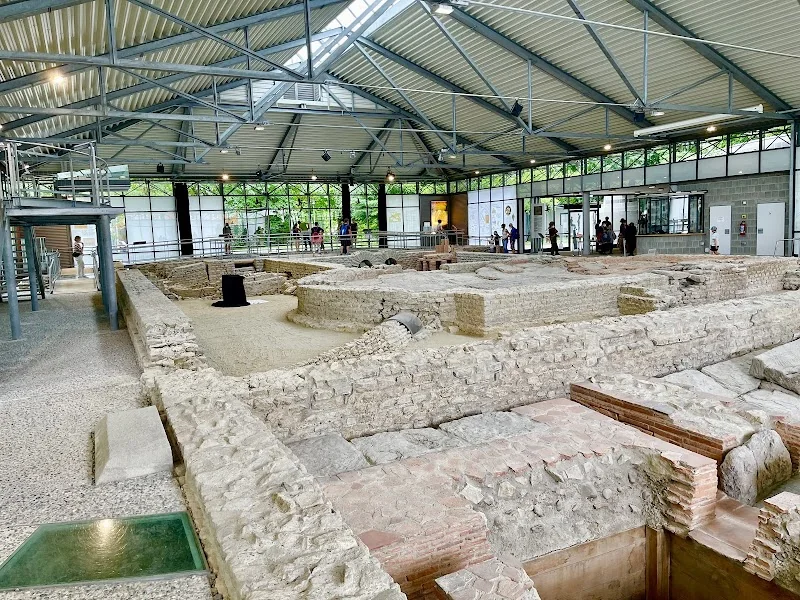
The Small Baths are among the most impressive exhibition areas of the Archaeological Park Cambodunum because they make the original substance of the Roman city directly experienceable. The protective and exhibition building presents the original remains of the ancient bathing facility of the governor of Cambodunum. Original finds from the excavations provide insight into the ancient wellness culture of the city. This is not a romanticized view of antiquity but a concrete archaeological mediation: One sees how a Roman bathing area was structured and what role hygiene, comfort, and social representation played in the provincial capital. For visitors, this is particularly exciting because it is not only explained but also made visible how the Romans lived in everyday life. ([apc-kempten.de](https://apc-kempten.de/de/archaeologischer-park/ausstellungsareale/kleine-thermen))
Historically, the Small Baths are closely connected to the governor of the Roman province of Raetia. Next to the Forum stood a representative building, and adjacent to it, the Small Baths were built around 50 AD. They served as a private bathing facility for the governor, his staff, and his guests. Two generations later, the seat of the provincial governor was moved to Augusta Vindelicum, now Augsburg. After that, the palace complex of Cambodunum served as a guesthouse, and the associated Small Baths were remodeled and received a public latrine. This development makes the site archaeologically interesting because it directly reflects a change in political significance and usage. ([apc-kempten.de](https://apc-kempten.de/de/archaeologischer-park/ausstellungsareale/kleine-thermen))
Today, those visiting the Small Baths experience not just a ruin but a place with multiple layers of time. The protective building preserves the sensitive remains while also making the spatial situation understandable. For the search intent regarding images and photos, this area is particularly attractive because the preserved walls, exhibition elements, and integration into the park landscape create strong visual impressions. This also applies to the overall complex of the APC, where the Small Baths are not isolated but embedded in a larger ancient cityscape. Thus, the visit does not become a brief individual stop, but a cultural-historical tour with recognizable connections. ([apc-kempten.de](https://apc-kempten.de/de/archaeologischer-park/ausstellungsareale/kleine-thermen))
Forum, Basilica, and Gallic-Roman Temple District as the Heart of the Roman City
The Archaeological Park Cambodunum thrives not only on the Small Baths but on the entirety of its exhibition areas. The Forum and Basilica showcase the center of public life in the ancient city. The Forum was the focal point of Cambodunum and formed the center of city administration and public life in antiquity. Market days took place in the square, and meetings and court proceedings were held in the Basilica. The monumental buildings were already constructed in stone around 40 AD. Today, the forum area in the public park is freely accessible at any time, which is very pleasant for visitors because one can experience the area independently of a classic museum opening. ([apc-kempten.de](https://apc-kempten.de/de/archaeologischer-park/ausstellungsareale/forum-und-basilika))
The Gallic-Roman temple district is the second major key location in the park. It was considered one of the most significant Roman cult sites in present-day Bavaria. There, residents of different origins brought their religious beliefs, including Roman-influenced Celts from neighboring Gaul, Germans, and Romans. The temple district, with its altars and temples, was surrounded by a double hall and is now viewable as a partial reconstruction at the original site. Since 2022, an interactive permanent exhibition has complemented the area and explains the belief system of Cambodunum in a modern way. For visitors, this means: The APC not only shows stones but also makes the religion, politics, and everyday culture of a Roman city in southern Germany comprehensible. ([apc-kempten.de](https://www.apc-kempten.de/de/archaeologischer-park/ausstellungsareale/galloroemischer-tempelbezirk))
From an SEO perspective, these two themes are very important for the location because they cover the search intent around the temple district and Forum and Basilica. For the actual visit, the combination is also ideal. One can understand the Small Baths as a bathing facility, the temple district as a place of Roman religion, and the Forum as an urban center. Together, these stations create a cohesive picture of the provincial capital. Therefore, those seeking the greatest content value should not only look at individual photos but also consider the entire historical context. This connection makes the APC a strong destination for culture enthusiasts, families, and school groups. ([apc-kempten.de](https://apc-kempten.de/de/archaeologischer-park/ausstellungsareale/galloroemischer-tempelbezirk))
Accessibility, Tours, and Family Offers at the APC
The Archaeological Park Cambodunum is not only historically important but also comparatively well organized for different visitor groups. On the accessibility page, the APC points out that it has been classified according to the criteria of Travel for All. This is a relevant signal for many guests because it allows them to better assess before the visit whether the site meets their needs. Furthermore, the park claims to continuously work on further reducing barriers. This self-commitment shows that the topic is not treated as a side note. ([apc-kempten.de](https://apc-kempten.de/de/barrierefreiheit))
Concrete aids are also documented. In the temple district and the Small Baths, there are accessible toilets, wheelchairs available for free rental at both ticket counters, and both the exhibition area in the temple district and the visitor path in the Small Baths are accessible via ramps. The outdoor tour in the park runs along paths with a water-bound surface, which can be more difficult depending on the weather. For people with limited mobility, this is an important note because it allows for a more realistic planning of the visit. Additionally, the APC also offers magnifying glasses or reading glasses upon request. ([apc-kempten.de](https://apc-kempten.de/de/besucherinfo))
The APC is also well-equipped in terms of mediation. The official pages mention tours with figures, costume tours, children's tours, theater tours, tactile tours, and tours in German sign language. For blind and visually impaired individuals, there are tactile tours with haptic stations, and for hearing-impaired guests, additional offerings in sign language. Families also find children's workshops, children's birthdays, and painting offers in the park's surroundings. This shows: The APC is not only suitable for quiet individual visits but also for groups, families, and visitors with different needs. For this reason, search inquiries regarding tours and accessibility cover a very real interest here. ([apc-kempten.de](https://apc-kempten.de/de/barrierefreiheit))
Photos, Impressions, and Practical Visiting Tips for the Small Baths
Those searching for photos, images, or impressions before their visit will find a very photogenic mix of archaeological remains, reconstructions, and landscape in the Archaeological Park Cambodunum. Particularly striking are the partially reconstructed temple district, the freely accessible forum level, and the protective architecture of the Small Baths. The park also works strongly visually with images, overview plans, and digital offerings. On the homepage and in the exhibition areas, numerous image motifs are integrated, and the APC also refers to its digital content such as app, media library, and blog. For visitors who want to get an idea in advance, this is helpful because they can already recognize which stations particularly interest them before the actual tour. ([apc-kempten.de](https://www.apc-kempten.de/?utm_source=openai))
Practically, it is worthwhile to plan the visit as a small tour through several thematic rooms. The Small Baths convey the world of bathing and ancient representation, the temple district focuses on religion and cult, and the Forum with Basilica showcases public life. Therefore, those who rely on a good mix of history and atmosphere will get both here. The site is largely accessible as an open-air museum; however, one should wear weather-appropriate shoes and, if necessary, plan a bit more time for the paths. Since there is no dedicated parking lot and the walk from the surrounding parking areas is on foot, a relaxed visiting mode is sensible. This way, a short photo stop becomes a rounded experience with real added value. ([apc-kempten.de](https://apc-kempten.de/de/besucherinfo))
For inquiries regarding reviews: The best impression is created on-site because the strength of the APC lies in the combination of original remains, reconstructions, and open parkland. Those who want to experience the site in a structured way should start or end with the Small Baths, plan the temple district with the exhibition, and then include the Forum and Basilica. This way, one not only gets beautiful photos but also the historical context. This is exactly what makes the APC in Kempten a convincing choice for guests looking for more than just a single sight. ([apc-kempten.de](https://apc-kempten.de/de/archaeologischer-park/ausstellungsareale/kleine-thermen))
Sources:
Mehr anzeigenWeniger anzeigen
Archaeological Park Cambodunum Small Baths | Opening Hours
The Archaeological Park Cambodunum in Kempten is not a classic museum that one experiences only from the inside, but a spacious Roman open-air museum with clearly recognizable exhibition areas, open parkland, and several entrances. The main highlights include the Gallic-Roman temple district, the Small Baths, as well as the Forum and Basilica. For this reason, visitors are not only looking for history but also very specifically for opening hours, directions, parking, tickets, images, and orientation on site. The Small Baths are particularly exciting because they show original remains of an ancient bathing facility and provide a direct glimpse into the everyday world of the Roman era. The park is located on the high bank of the Iller in the Kempten-Ost district and is open from March 15 to November 15, 2026, Tuesday to Sunday from 10 am to 5 pm. ([apc-kempten.de](https://www.apc-kempten.de/?utm_source=openai))
The site is relevant for different search intents: Those looking for opening hours need quick facts. Those searching for photos or reviews want to gather impressions. Those looking for directions or parking need practical information for their visit. And those interested in the Small Baths want to know what is historically visible there and why the site is so important for Kempten. The APC meets these expectations with a compact but content-rich offer: two ticket counters, clear pathways, a publicly accessible forum area, a partial reconstruction of the temple district, and additional digital and family-friendly offerings. This combination makes the site a strong destination for day trips, educational visits, and culturally interested guests. ([apc-kempten.de](https://apc-kempten.de/de/besucherinfo))
Opening Hours, Tickets, and Admission Prices for the Small Baths
The opening hours are one of the most important search reasons for the Archaeological Park Cambodunum. For the 2026 season, the official visitor information states that it will be open from March 15 to November 15, each Tuesday to Sunday between 10 am and 5 pm. It is clear: The APC is a seasonal open-air museum that is visited in the warm months and is not open daily year-round. Additionally, there is a holiday regulation. The park is open on Good Friday, Easter Sunday, Easter Monday, Labor Day, Ascension Day, Whit Monday, Corpus Christi, Assumption Day, German Unity Day, and All Saints' Day. It remains closed on Shrove Tuesday. This is important for visitors because the timing of an outing should be very specifically oriented around these times. ([apc-kempten.de](https://apc-kempten.de/de/besucherinfo))
Regarding tickets, the APC offers a simple and transparent structure. Adults pay 5 euros. Children and teenagers up to 17 years old, as well as students, have free admission. Reduced tickets cost 2.50 euros. For groups of ten or more, the same 2.50 euros per person applies, and on the first Sunday of each month, admission is free. Those who want to prepare for their visit comfortably can also purchase tickets online but must pick them up at the temple district ticket counter. This is a practical tip for anyone looking to avoid waiting times or plan their day early. The official pages also mention an annual pass price of 15 euros for adults. This can be worthwhile for guests from Kempten and the Allgäu if they plan to visit the park not just once but multiple times. ([apc-kempten.de](https://apc-kempten.de/de/besucherinfo))
It is also important to note the exact ticket and cash register locations, as the park has more than one entrance. Admission tickets are available at both the temple district cash register at Cambodunumweg 3 and at the Small Baths at Merktstraße 1. This facilitates the visit because one does not necessarily have to start at the main entrance. Those who decide spontaneously to take the tour can therefore enter at either end on site. For the search intent regarding tickets and admission prices, this is a significant advantage: The APC is not only historically interesting but also organizationally manageable and practical. ([apc-kempten.de](https://apc-kempten.de/de/besucherinfo))
Directions, Parking, and Location on the High Bank of the Iller
The directions to the Archaeological Park Cambodunum are well documented and understandable for visitors arriving by car or bus. By car, the route according to the official visitor information leads via the A7, B12, or B19 to Kempten. Then, one should drive towards the main train station at Berliner Platz and follow the signs to the Archaeological Park Cambodunum. The APC is located on the high bank of the Iller in the Kempten-Ost district. The navigation addresses provided are Cambodunumweg 3 and Merktstraße 1. This information is especially important for guests who want to specifically target the Small Baths and do not want to start at the central entrance. The location on the high bank makes the park architecturally prominent, while also being well integrated into the urban area. ([apc-kempten.de](https://apc-kempten.de/de/besucherinfo))
Regarding parking: There is no dedicated APC parking lot. Visitors are advised to use the parking spaces in the vicinity, such as the Illerdamm parking lot or the Brodkorbweg parking lot. From there, the walking time is approximately 5 to 15 minutes. For those searching for parking or a parking space, this is one of the most important pieces of information because it avoids false expectations. Instead of a direct access to the ticket counters, one should plan for a short walk. This fits well with the character of an open-air museum, where the journey itself is part of the experience. Those traveling with children, wheelchairs, or walkers can better plan the route in advance, as the park consists of several areas and the paths are interconnected. ([apc-kempten.de](https://apc-kempten.de/de/besucherinfo))
The APC is also accessible by public transport. From the ZUM, the central transfer point in Kempten, lines 11 and 12 run. Additionally, the park is connected via line R8 from the main train station. Several bus stops are nearby, including Schumacherring/APC, Kaufbeurer Straße/Augarten, and Lenzfrieder Straße/Kieswerk. This makes the visit particularly interesting for travelers without a car, for school classes, and for anyone looking to avoid parking. Especially for inquiries about directions, this combination of public transport and walking is very relevant because it shows that the park is not isolated but well integrated into the city's logistics. ([apc-kempten.de](https://apc-kempten.de/de/besucherinfo))
Small Baths: Original Remains of the Ancient Bathing Facility
The Small Baths are among the most impressive exhibition areas of the Archaeological Park Cambodunum because they make the original substance of the Roman city directly experienceable. The protective and exhibition building presents the original remains of the ancient bathing facility of the governor of Cambodunum. Original finds from the excavations provide insight into the ancient wellness culture of the city. This is not a romanticized view of antiquity but a concrete archaeological mediation: One sees how a Roman bathing area was structured and what role hygiene, comfort, and social representation played in the provincial capital. For visitors, this is particularly exciting because it is not only explained but also made visible how the Romans lived in everyday life. ([apc-kempten.de](https://apc-kempten.de/de/archaeologischer-park/ausstellungsareale/kleine-thermen))
Historically, the Small Baths are closely connected to the governor of the Roman province of Raetia. Next to the Forum stood a representative building, and adjacent to it, the Small Baths were built around 50 AD. They served as a private bathing facility for the governor, his staff, and his guests. Two generations later, the seat of the provincial governor was moved to Augusta Vindelicum, now Augsburg. After that, the palace complex of Cambodunum served as a guesthouse, and the associated Small Baths were remodeled and received a public latrine. This development makes the site archaeologically interesting because it directly reflects a change in political significance and usage. ([apc-kempten.de](https://apc-kempten.de/de/archaeologischer-park/ausstellungsareale/kleine-thermen))
Today, those visiting the Small Baths experience not just a ruin but a place with multiple layers of time. The protective building preserves the sensitive remains while also making the spatial situation understandable. For the search intent regarding images and photos, this area is particularly attractive because the preserved walls, exhibition elements, and integration into the park landscape create strong visual impressions. This also applies to the overall complex of the APC, where the Small Baths are not isolated but embedded in a larger ancient cityscape. Thus, the visit does not become a brief individual stop, but a cultural-historical tour with recognizable connections. ([apc-kempten.de](https://apc-kempten.de/de/archaeologischer-park/ausstellungsareale/kleine-thermen))
Forum, Basilica, and Gallic-Roman Temple District as the Heart of the Roman City
The Archaeological Park Cambodunum thrives not only on the Small Baths but on the entirety of its exhibition areas. The Forum and Basilica showcase the center of public life in the ancient city. The Forum was the focal point of Cambodunum and formed the center of city administration and public life in antiquity. Market days took place in the square, and meetings and court proceedings were held in the Basilica. The monumental buildings were already constructed in stone around 40 AD. Today, the forum area in the public park is freely accessible at any time, which is very pleasant for visitors because one can experience the area independently of a classic museum opening. ([apc-kempten.de](https://apc-kempten.de/de/archaeologischer-park/ausstellungsareale/forum-und-basilika))
The Gallic-Roman temple district is the second major key location in the park. It was considered one of the most significant Roman cult sites in present-day Bavaria. There, residents of different origins brought their religious beliefs, including Roman-influenced Celts from neighboring Gaul, Germans, and Romans. The temple district, with its altars and temples, was surrounded by a double hall and is now viewable as a partial reconstruction at the original site. Since 2022, an interactive permanent exhibition has complemented the area and explains the belief system of Cambodunum in a modern way. For visitors, this means: The APC not only shows stones but also makes the religion, politics, and everyday culture of a Roman city in southern Germany comprehensible. ([apc-kempten.de](https://www.apc-kempten.de/de/archaeologischer-park/ausstellungsareale/galloroemischer-tempelbezirk))
From an SEO perspective, these two themes are very important for the location because they cover the search intent around the temple district and Forum and Basilica. For the actual visit, the combination is also ideal. One can understand the Small Baths as a bathing facility, the temple district as a place of Roman religion, and the Forum as an urban center. Together, these stations create a cohesive picture of the provincial capital. Therefore, those seeking the greatest content value should not only look at individual photos but also consider the entire historical context. This connection makes the APC a strong destination for culture enthusiasts, families, and school groups. ([apc-kempten.de](https://apc-kempten.de/de/archaeologischer-park/ausstellungsareale/galloroemischer-tempelbezirk))
Accessibility, Tours, and Family Offers at the APC
The Archaeological Park Cambodunum is not only historically important but also comparatively well organized for different visitor groups. On the accessibility page, the APC points out that it has been classified according to the criteria of Travel for All. This is a relevant signal for many guests because it allows them to better assess before the visit whether the site meets their needs. Furthermore, the park claims to continuously work on further reducing barriers. This self-commitment shows that the topic is not treated as a side note. ([apc-kempten.de](https://apc-kempten.de/de/barrierefreiheit))
Concrete aids are also documented. In the temple district and the Small Baths, there are accessible toilets, wheelchairs available for free rental at both ticket counters, and both the exhibition area in the temple district and the visitor path in the Small Baths are accessible via ramps. The outdoor tour in the park runs along paths with a water-bound surface, which can be more difficult depending on the weather. For people with limited mobility, this is an important note because it allows for a more realistic planning of the visit. Additionally, the APC also offers magnifying glasses or reading glasses upon request. ([apc-kempten.de](https://apc-kempten.de/de/besucherinfo))
The APC is also well-equipped in terms of mediation. The official pages mention tours with figures, costume tours, children's tours, theater tours, tactile tours, and tours in German sign language. For blind and visually impaired individuals, there are tactile tours with haptic stations, and for hearing-impaired guests, additional offerings in sign language. Families also find children's workshops, children's birthdays, and painting offers in the park's surroundings. This shows: The APC is not only suitable for quiet individual visits but also for groups, families, and visitors with different needs. For this reason, search inquiries regarding tours and accessibility cover a very real interest here. ([apc-kempten.de](https://apc-kempten.de/de/barrierefreiheit))
Photos, Impressions, and Practical Visiting Tips for the Small Baths
Those searching for photos, images, or impressions before their visit will find a very photogenic mix of archaeological remains, reconstructions, and landscape in the Archaeological Park Cambodunum. Particularly striking are the partially reconstructed temple district, the freely accessible forum level, and the protective architecture of the Small Baths. The park also works strongly visually with images, overview plans, and digital offerings. On the homepage and in the exhibition areas, numerous image motifs are integrated, and the APC also refers to its digital content such as app, media library, and blog. For visitors who want to get an idea in advance, this is helpful because they can already recognize which stations particularly interest them before the actual tour. ([apc-kempten.de](https://www.apc-kempten.de/?utm_source=openai))
Practically, it is worthwhile to plan the visit as a small tour through several thematic rooms. The Small Baths convey the world of bathing and ancient representation, the temple district focuses on religion and cult, and the Forum with Basilica showcases public life. Therefore, those who rely on a good mix of history and atmosphere will get both here. The site is largely accessible as an open-air museum; however, one should wear weather-appropriate shoes and, if necessary, plan a bit more time for the paths. Since there is no dedicated parking lot and the walk from the surrounding parking areas is on foot, a relaxed visiting mode is sensible. This way, a short photo stop becomes a rounded experience with real added value. ([apc-kempten.de](https://apc-kempten.de/de/besucherinfo))
For inquiries regarding reviews: The best impression is created on-site because the strength of the APC lies in the combination of original remains, reconstructions, and open parkland. Those who want to experience the site in a structured way should start or end with the Small Baths, plan the temple district with the exhibition, and then include the Forum and Basilica. This way, one not only gets beautiful photos but also the historical context. This is exactly what makes the APC in Kempten a convincing choice for guests looking for more than just a single sight. ([apc-kempten.de](https://apc-kempten.de/de/archaeologischer-park/ausstellungsareale/kleine-thermen))
Sources:
Archaeological Park Cambodunum Small Baths | Opening Hours
The Archaeological Park Cambodunum in Kempten is not a classic museum that one experiences only from the inside, but a spacious Roman open-air museum with clearly recognizable exhibition areas, open parkland, and several entrances. The main highlights include the Gallic-Roman temple district, the Small Baths, as well as the Forum and Basilica. For this reason, visitors are not only looking for history but also very specifically for opening hours, directions, parking, tickets, images, and orientation on site. The Small Baths are particularly exciting because they show original remains of an ancient bathing facility and provide a direct glimpse into the everyday world of the Roman era. The park is located on the high bank of the Iller in the Kempten-Ost district and is open from March 15 to November 15, 2026, Tuesday to Sunday from 10 am to 5 pm. ([apc-kempten.de](https://www.apc-kempten.de/?utm_source=openai))
The site is relevant for different search intents: Those looking for opening hours need quick facts. Those searching for photos or reviews want to gather impressions. Those looking for directions or parking need practical information for their visit. And those interested in the Small Baths want to know what is historically visible there and why the site is so important for Kempten. The APC meets these expectations with a compact but content-rich offer: two ticket counters, clear pathways, a publicly accessible forum area, a partial reconstruction of the temple district, and additional digital and family-friendly offerings. This combination makes the site a strong destination for day trips, educational visits, and culturally interested guests. ([apc-kempten.de](https://apc-kempten.de/de/besucherinfo))
Opening Hours, Tickets, and Admission Prices for the Small Baths
The opening hours are one of the most important search reasons for the Archaeological Park Cambodunum. For the 2026 season, the official visitor information states that it will be open from March 15 to November 15, each Tuesday to Sunday between 10 am and 5 pm. It is clear: The APC is a seasonal open-air museum that is visited in the warm months and is not open daily year-round. Additionally, there is a holiday regulation. The park is open on Good Friday, Easter Sunday, Easter Monday, Labor Day, Ascension Day, Whit Monday, Corpus Christi, Assumption Day, German Unity Day, and All Saints' Day. It remains closed on Shrove Tuesday. This is important for visitors because the timing of an outing should be very specifically oriented around these times. ([apc-kempten.de](https://apc-kempten.de/de/besucherinfo))
Regarding tickets, the APC offers a simple and transparent structure. Adults pay 5 euros. Children and teenagers up to 17 years old, as well as students, have free admission. Reduced tickets cost 2.50 euros. For groups of ten or more, the same 2.50 euros per person applies, and on the first Sunday of each month, admission is free. Those who want to prepare for their visit comfortably can also purchase tickets online but must pick them up at the temple district ticket counter. This is a practical tip for anyone looking to avoid waiting times or plan their day early. The official pages also mention an annual pass price of 15 euros for adults. This can be worthwhile for guests from Kempten and the Allgäu if they plan to visit the park not just once but multiple times. ([apc-kempten.de](https://apc-kempten.de/de/besucherinfo))
It is also important to note the exact ticket and cash register locations, as the park has more than one entrance. Admission tickets are available at both the temple district cash register at Cambodunumweg 3 and at the Small Baths at Merktstraße 1. This facilitates the visit because one does not necessarily have to start at the main entrance. Those who decide spontaneously to take the tour can therefore enter at either end on site. For the search intent regarding tickets and admission prices, this is a significant advantage: The APC is not only historically interesting but also organizationally manageable and practical. ([apc-kempten.de](https://apc-kempten.de/de/besucherinfo))
Directions, Parking, and Location on the High Bank of the Iller
The directions to the Archaeological Park Cambodunum are well documented and understandable for visitors arriving by car or bus. By car, the route according to the official visitor information leads via the A7, B12, or B19 to Kempten. Then, one should drive towards the main train station at Berliner Platz and follow the signs to the Archaeological Park Cambodunum. The APC is located on the high bank of the Iller in the Kempten-Ost district. The navigation addresses provided are Cambodunumweg 3 and Merktstraße 1. This information is especially important for guests who want to specifically target the Small Baths and do not want to start at the central entrance. The location on the high bank makes the park architecturally prominent, while also being well integrated into the urban area. ([apc-kempten.de](https://apc-kempten.de/de/besucherinfo))
Regarding parking: There is no dedicated APC parking lot. Visitors are advised to use the parking spaces in the vicinity, such as the Illerdamm parking lot or the Brodkorbweg parking lot. From there, the walking time is approximately 5 to 15 minutes. For those searching for parking or a parking space, this is one of the most important pieces of information because it avoids false expectations. Instead of a direct access to the ticket counters, one should plan for a short walk. This fits well with the character of an open-air museum, where the journey itself is part of the experience. Those traveling with children, wheelchairs, or walkers can better plan the route in advance, as the park consists of several areas and the paths are interconnected. ([apc-kempten.de](https://apc-kempten.de/de/besucherinfo))
The APC is also accessible by public transport. From the ZUM, the central transfer point in Kempten, lines 11 and 12 run. Additionally, the park is connected via line R8 from the main train station. Several bus stops are nearby, including Schumacherring/APC, Kaufbeurer Straße/Augarten, and Lenzfrieder Straße/Kieswerk. This makes the visit particularly interesting for travelers without a car, for school classes, and for anyone looking to avoid parking. Especially for inquiries about directions, this combination of public transport and walking is very relevant because it shows that the park is not isolated but well integrated into the city's logistics. ([apc-kempten.de](https://apc-kempten.de/de/besucherinfo))
Small Baths: Original Remains of the Ancient Bathing Facility
The Small Baths are among the most impressive exhibition areas of the Archaeological Park Cambodunum because they make the original substance of the Roman city directly experienceable. The protective and exhibition building presents the original remains of the ancient bathing facility of the governor of Cambodunum. Original finds from the excavations provide insight into the ancient wellness culture of the city. This is not a romanticized view of antiquity but a concrete archaeological mediation: One sees how a Roman bathing area was structured and what role hygiene, comfort, and social representation played in the provincial capital. For visitors, this is particularly exciting because it is not only explained but also made visible how the Romans lived in everyday life. ([apc-kempten.de](https://apc-kempten.de/de/archaeologischer-park/ausstellungsareale/kleine-thermen))
Historically, the Small Baths are closely connected to the governor of the Roman province of Raetia. Next to the Forum stood a representative building, and adjacent to it, the Small Baths were built around 50 AD. They served as a private bathing facility for the governor, his staff, and his guests. Two generations later, the seat of the provincial governor was moved to Augusta Vindelicum, now Augsburg. After that, the palace complex of Cambodunum served as a guesthouse, and the associated Small Baths were remodeled and received a public latrine. This development makes the site archaeologically interesting because it directly reflects a change in political significance and usage. ([apc-kempten.de](https://apc-kempten.de/de/archaeologischer-park/ausstellungsareale/kleine-thermen))
Today, those visiting the Small Baths experience not just a ruin but a place with multiple layers of time. The protective building preserves the sensitive remains while also making the spatial situation understandable. For the search intent regarding images and photos, this area is particularly attractive because the preserved walls, exhibition elements, and integration into the park landscape create strong visual impressions. This also applies to the overall complex of the APC, where the Small Baths are not isolated but embedded in a larger ancient cityscape. Thus, the visit does not become a brief individual stop, but a cultural-historical tour with recognizable connections. ([apc-kempten.de](https://apc-kempten.de/de/archaeologischer-park/ausstellungsareale/kleine-thermen))
Forum, Basilica, and Gallic-Roman Temple District as the Heart of the Roman City
The Archaeological Park Cambodunum thrives not only on the Small Baths but on the entirety of its exhibition areas. The Forum and Basilica showcase the center of public life in the ancient city. The Forum was the focal point of Cambodunum and formed the center of city administration and public life in antiquity. Market days took place in the square, and meetings and court proceedings were held in the Basilica. The monumental buildings were already constructed in stone around 40 AD. Today, the forum area in the public park is freely accessible at any time, which is very pleasant for visitors because one can experience the area independently of a classic museum opening. ([apc-kempten.de](https://apc-kempten.de/de/archaeologischer-park/ausstellungsareale/forum-und-basilika))
The Gallic-Roman temple district is the second major key location in the park. It was considered one of the most significant Roman cult sites in present-day Bavaria. There, residents of different origins brought their religious beliefs, including Roman-influenced Celts from neighboring Gaul, Germans, and Romans. The temple district, with its altars and temples, was surrounded by a double hall and is now viewable as a partial reconstruction at the original site. Since 2022, an interactive permanent exhibition has complemented the area and explains the belief system of Cambodunum in a modern way. For visitors, this means: The APC not only shows stones but also makes the religion, politics, and everyday culture of a Roman city in southern Germany comprehensible. ([apc-kempten.de](https://www.apc-kempten.de/de/archaeologischer-park/ausstellungsareale/galloroemischer-tempelbezirk))
From an SEO perspective, these two themes are very important for the location because they cover the search intent around the temple district and Forum and Basilica. For the actual visit, the combination is also ideal. One can understand the Small Baths as a bathing facility, the temple district as a place of Roman religion, and the Forum as an urban center. Together, these stations create a cohesive picture of the provincial capital. Therefore, those seeking the greatest content value should not only look at individual photos but also consider the entire historical context. This connection makes the APC a strong destination for culture enthusiasts, families, and school groups. ([apc-kempten.de](https://apc-kempten.de/de/archaeologischer-park/ausstellungsareale/galloroemischer-tempelbezirk))
Accessibility, Tours, and Family Offers at the APC
The Archaeological Park Cambodunum is not only historically important but also comparatively well organized for different visitor groups. On the accessibility page, the APC points out that it has been classified according to the criteria of Travel for All. This is a relevant signal for many guests because it allows them to better assess before the visit whether the site meets their needs. Furthermore, the park claims to continuously work on further reducing barriers. This self-commitment shows that the topic is not treated as a side note. ([apc-kempten.de](https://apc-kempten.de/de/barrierefreiheit))
Concrete aids are also documented. In the temple district and the Small Baths, there are accessible toilets, wheelchairs available for free rental at both ticket counters, and both the exhibition area in the temple district and the visitor path in the Small Baths are accessible via ramps. The outdoor tour in the park runs along paths with a water-bound surface, which can be more difficult depending on the weather. For people with limited mobility, this is an important note because it allows for a more realistic planning of the visit. Additionally, the APC also offers magnifying glasses or reading glasses upon request. ([apc-kempten.de](https://apc-kempten.de/de/besucherinfo))
The APC is also well-equipped in terms of mediation. The official pages mention tours with figures, costume tours, children's tours, theater tours, tactile tours, and tours in German sign language. For blind and visually impaired individuals, there are tactile tours with haptic stations, and for hearing-impaired guests, additional offerings in sign language. Families also find children's workshops, children's birthdays, and painting offers in the park's surroundings. This shows: The APC is not only suitable for quiet individual visits but also for groups, families, and visitors with different needs. For this reason, search inquiries regarding tours and accessibility cover a very real interest here. ([apc-kempten.de](https://apc-kempten.de/de/barrierefreiheit))
Photos, Impressions, and Practical Visiting Tips for the Small Baths
Those searching for photos, images, or impressions before their visit will find a very photogenic mix of archaeological remains, reconstructions, and landscape in the Archaeological Park Cambodunum. Particularly striking are the partially reconstructed temple district, the freely accessible forum level, and the protective architecture of the Small Baths. The park also works strongly visually with images, overview plans, and digital offerings. On the homepage and in the exhibition areas, numerous image motifs are integrated, and the APC also refers to its digital content such as app, media library, and blog. For visitors who want to get an idea in advance, this is helpful because they can already recognize which stations particularly interest them before the actual tour. ([apc-kempten.de](https://www.apc-kempten.de/?utm_source=openai))
Practically, it is worthwhile to plan the visit as a small tour through several thematic rooms. The Small Baths convey the world of bathing and ancient representation, the temple district focuses on religion and cult, and the Forum with Basilica showcases public life. Therefore, those who rely on a good mix of history and atmosphere will get both here. The site is largely accessible as an open-air museum; however, one should wear weather-appropriate shoes and, if necessary, plan a bit more time for the paths. Since there is no dedicated parking lot and the walk from the surrounding parking areas is on foot, a relaxed visiting mode is sensible. This way, a short photo stop becomes a rounded experience with real added value. ([apc-kempten.de](https://apc-kempten.de/de/besucherinfo))
For inquiries regarding reviews: The best impression is created on-site because the strength of the APC lies in the combination of original remains, reconstructions, and open parkland. Those who want to experience the site in a structured way should start or end with the Small Baths, plan the temple district with the exhibition, and then include the Forum and Basilica. This way, one not only gets beautiful photos but also the historical context. This is exactly what makes the APC in Kempten a convincing choice for guests looking for more than just a single sight. ([apc-kempten.de](https://apc-kempten.de/de/archaeologischer-park/ausstellungsareale/kleine-thermen))
Sources:
Frequently Asked Questions
Reviews
Joshua Herring
6. October 2017
Amazingly well kept and large grounds and ruins. They're still excavating certain parts of the area. Has a restaurant and play area for kids and some adults.
Matthias Sachse
20. May 2026
The Archaeological Park Cambodunum – Small Baths offers an exciting insight into the Roman past of Kempten and impressively shows how significant the city was even in ancient times. The well-preserved remains of the former bathing facility provide a fascinating picture of daily life and bathing culture during Roman times. Particularly interesting are the historical structures and the informative displays on site, which allow you to vividly imagine life back then. Despite the historical background, the site feels pleasantly calm and invites you to discover history in a relaxed atmosphere. The Small Baths are a lovely part of the Archaeological Park Cambodunum and can be wonderfully combined with the other attractions on the grounds. A worthwhile place for anyone interested in history, archaeology, and Roman culture.
U.
8. June 2026
Excavations of a bath complex with very good explanations and models. Accessible by public buses and parking is nearby.
Uwe Ohneburg
21. June 2025
Not only the underfloor heating, but also the heated bath comes from the Romans. And how complicated that was can be seen here. Quite interesting. With the admission, you also get access to the temple district.
Joachim Braun
10. March 2024
Partially well-preserved excavations and reconstructions. There wasn't a guided tour at the beginning of the season, but it's especially necessary for school classes or travel groups. There's a lot of text to read on all aspects of life during Roman times. However, that requires more time than I had available. A guided tour can provide a structured introduction.